
Two roles distinguished within experience
The Transcendental Aesthetic of the Critique of Pure Reason examines how objects are given sensibly. The Transcendental Logic that follows examines the capacity to think them. This sequence is not a physiological timetable in which the eyes act first and the brain starts later. It separates roles within an experience. Both roles are involved when we claim to know an object.
Intuition here does not mean an unsupported hunch. In Kant's terminology, an intuition is a singular representation directly related to its object, while a concept is a general representation applicable to multiple objects. The cup before you and the concept of a cup offer a starting distinction. However, the empirical concept cup should not be identified with the pure concepts of understanding, or categories.
This lesson connects the Aesthetic's discussion of space and time, the introduction to logic at A50/B74–A51/B75, and the Second Analogy on causality. The aim is to examine the assumption that accumulating sensory material automatically produces knowledge. One short example cannot prove Kant's complete deduction of the categories. Understanding the distinctions should leave us aware of what further argument is required.
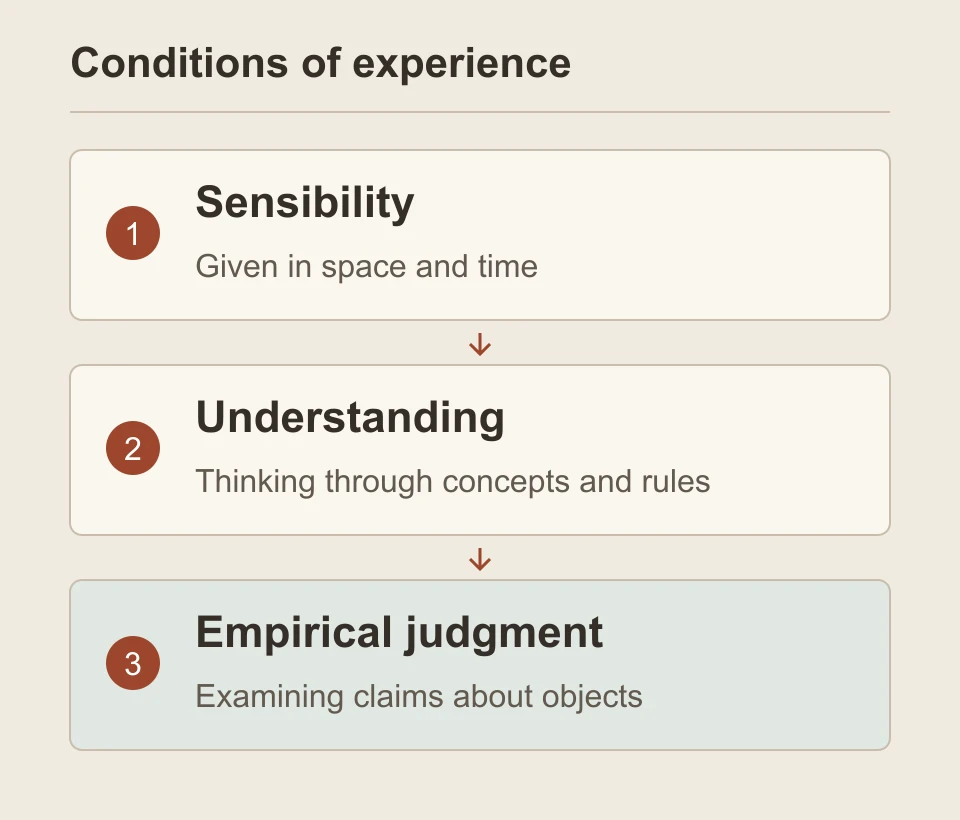
An original diagram distinguishing roles in cognition, not a biological or temporal sequence.
Space, time, intuition, concepts, and causality
Sensibility is the receptivity through which we acquire representations by being affected by objects. Receptivity does not mean inferiority or uselessness. Without something being given, we do not acquire knowledge of an object. Understanding thinks what is given through concepts. Removing either role and trying to explain complete cognition through the other returns us to the problem Kant wants to address.
Space is presented as the form in which external objects are experienced alongside and outside one another. Kant does not treat it as an ordinary common concept abstracted after encountering various external things. His argument runs in the other direction: spatial relations must already be possible for us to experience things as outside one another. This differs from investigating whether a particular place is empty. It separates the content of experience from the form in which that content is given.
Time is the form in which representations are experienced in succession and duration. Temporal relations are necessary for judging events as simultaneous or successive. This does not mean that every ordering begins only after we learn to read a clock. Nor does it guarantee the accuracy of an actual clock a priori. Claims about temporal form and claims about a particular measurement procedure must be examined separately.
If space and time are forms of our sensibility, does that make them false? Kant affirms their validity within experience while restricting the claim that they describe things independently of our cognitive conditions. Empirical reality and being a property of things in themselves are not equivalent claims. This prepares the distinction between appearances and things in themselves. It does not make ordinary objects disappear like a dream.
To identify understanding's role, consider what sensory material alone would provide. Receiving colors and shapes is different from grouping them as objects of a kind or judging that a change has occurred. Kant contrasts thought without content with intuition without concepts. Reducing this contrast to advice about balancing theory and practice misses the point. The distinction concerns the givenness and the thinking of an object.
This does not license attaching just any concept to sensory material. Concepts learned through experience, such as cup or tree, differ in role from categories such as causality or substance. Categories concern general ways of connecting objects in judgment. Kant must explain what entitles these pure concepts to apply to objects given in sensibility. Memorizing a list of twelve categories does not establish that entitlement.
Causality helps distinguish the order of perception from the objective order of an event. When looking at a building, you might notice the roof before the doorway, or reverse that sequence. When a boat moves downstream, its earlier and later positions belong to the event's order. In the Second Analogy, Kant uses this difference to investigate a rule distinguishing objective succession from a mere succession of my perceptions.
The principle of causality does not identify every particular cause in advance. Saying that a change stands in a lawful causal connection differs from saying that this equipment failure was caused by a wire. The second claim requires evidence and investigation. Knowing a philosophical category does not eliminate scientific experimentation. It helps separate the kind of connection sought from the particular connection actually discovered.
Synthesis concerns the connecting of representations into one experience. It is not equivalent to adding an arbitrary story. Listing a sound and a flash of light differs from judging them to be events occurring in a particular sequence in the same machine. For the connection to count as a judgment about the object, there must be a rule of combination and grounds for its application.
The cooperation of sensibility and understanding is therefore not a method of emotional regulation in which feelings are followed and then restrained by reason. Sensibility already involves the forms of space and time; understanding contributes concepts and rules for judging objects. Instead of choosing a superior faculty, explain what each provides. This challenges both the claim that direct observation contains no judgment and the claim that logical speech needs no evidence.
Empirical concepts can change with new observations. Someone who thought every cup had a handle may revise that classification on encountering one without a handle. The question about categories is different. It asks about the framework in which perceptions are understood as changes of the same object or events as following one another according to a rule. Revisable empirical classifications do not by themselves show that all conditions of cognition are matters of taste.
From material to a judgment about an object
Given
Objects are given to sensibility within the forms of space and time.
Thought
Understanding connects what is given through concepts and rules.
Investigated
Explaining a particular event's cause requires inquiry and empirical evidence.
This sequence separates roles. It is not a diagram of the temporal sequence of brain activity.
Do not reduce a priori conditions to personal bias
Do not identify a priori conditions with personal habits. Someone's tendency to notice bright colors first is a matter for the psychology of observation. Kant's question concerns the possibility of experience in general, beyond such individual differences. Contemporary findings in psychology or neuroscience cannot simply be attached as proofs of his philosophical claims.
The building and boat examples help us follow Kant's argument; they are not a decisive experiment settling every theory of causation. We can still debate whether his account adequately distinguishes event order from perceptual order. First identify what the author seeks to establish: a condition of experiencing objective events, rather than the cause of one particular event.
Fictional case: connecting sound and light
In this editorially invented sound exhibition, Doyun prepares a device whose button activates a light and a bell. A promotional video already carries the line that light awakens sound. But separate video recordings and device logs disagree about the order of the flash and the bell. The production team suggests selecting the best-looking video; Doyun wants to understand the discrepancy before settling the explanation. A phrase suited to an artistic title has slipped into the position of a claim about how the machine actually works.
Aligning the recordings' timestamps makes their sequences comparable. That sequence alone, however, cannot establish that the light caused the bell to ring. The technician explains that a controller sends separate signals to the light and bell. The bell still rings with the light switched off. Doyun sees that the repeatedly observed order, light followed by sound, differs from the claim that the light produces the sound. He has not discarded the sensory material; he has changed the account connecting it in response to further evidence.
This investigation is not an experiment proving Kant's Second Analogy. Kant asks what rule is required for experiencing an event in an objective sequence at all; Doyun seeks the particular cause operating in this device. Identifying that cause requires wiring information and operating records. Conversely, accumulating records without any rule of connection would leave unclear why they belong to the same event. The distinction between sensibility and understanding reveals the different roles of receiving an object and judging it, rather than supplying an answer that replaces empirical investigation.
When Doyun revises the promotional wording, the team regrets losing a poetic phrase. They retain it as the exhibition title but explain that one controller activates two outputs in the account of the machine. Figurative language has not disappeared; the claims made by the explanation have become clearer. Knowing the mechanism more accurately still does not take the investigators outside human cognitive conditions. The next lesson considers why improving empirical knowledge differs from crossing the boundary between appearances and things in themselves.
Facts, concepts, and application
- 01
Sensibility and emotion: sensibility names a cognitive capacity to receive objects. Equating it with liking or disliking obscures the discussion of space and time.
- 02
Intuition and concept: distinguish direct, singular representations from general representations. Neither alone explains complete cognition of an object.
- 03
Causal principle and particular cause: a condition for connecting events according to rules differs from an empirical explanation of which cause operated in this case.
Where to check the argument
This is an English localization of our original Korean lesson. Source arguments, editorial interpretation, and fictional applications are distinguished; no dialogue is presented as Kant speaking to a contemporary reader.
Read the sections and editions identified below alongside the explanation. AA refers to the Academy edition's volume and page; A/B identifies the two editions of the Critique of Pure Reason.
Independent reference: Stanford Encyclopedia of Philosophy: Immanuel Kant ↗