
What it means to establish peace
Perpetual Peace takes a treaty-like form, presenting preliminary and definitive articles. It first considers conditions that undermine peace, then asks what positive order could establish it. The scale differs from the Groundwork: relations between states cannot be addressed simply by advice that individuals should be good.
Our focus is the principal articles at AA 8:341–360. We check M. Campbell Smith's historical English translation while distinguishing the translator's substantial introduction from Kant's own text. This is original editorial explanation, not a legal guide to current international law or a particular state's policy.
Peace becomes unclear if its different senses are collapsed. No fighting at present, a treaty ending one war, and a relationship designed to prevent a return to war are different things. Kant argues that a state of peace must be established; the absence of a declaration of war is insufficient. Ask which source of instability each article addresses.
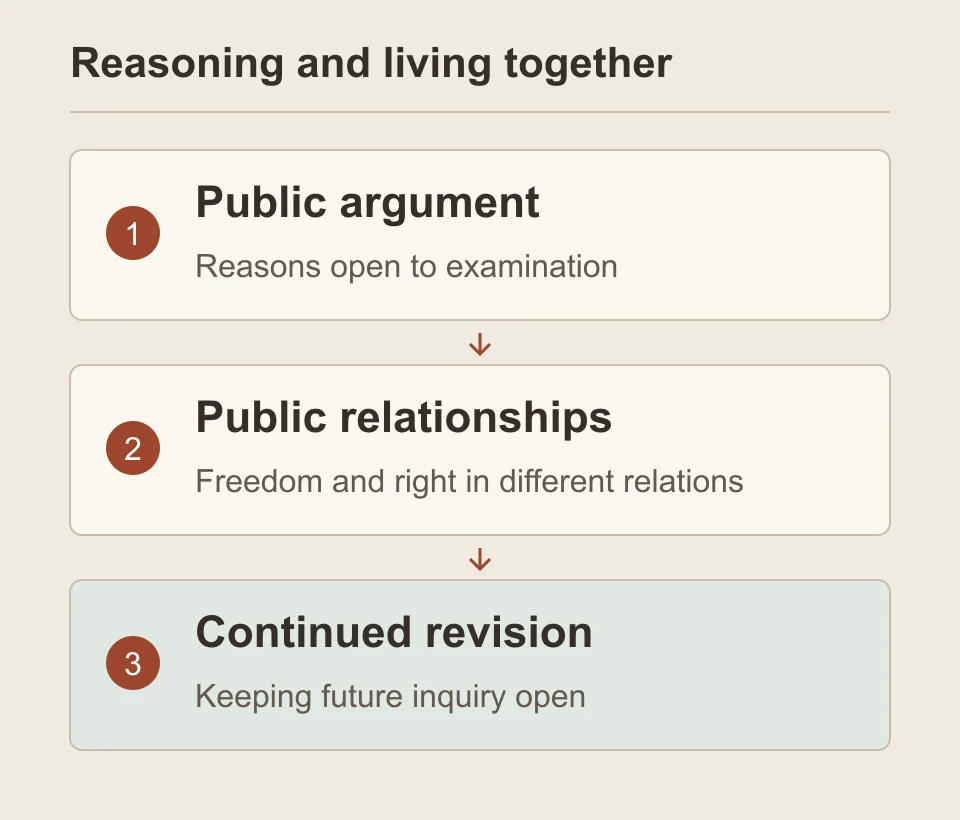
An original diagram connecting public argument, relationships, and revision. It is not a summary of contemporary law.
From preliminary articles to three public relationships
The first preliminary issue is a peace that secretly reserves grounds for another war. Fighting may stop while each side waits for an opportunity to attack again. Kant distinguishes that arrangement from genuine peace. The real reservations matter more than a document's title. Naming peace and changing the structure of conflict are different achievements.
The discussion of standing armies and war debt considers how military competition can generate its own incentives toward conflict. Permanent readiness increases others' anxiety and encourages rivalry. This is not a formula that immediately decides every modern defense policy. It concerns a relationship in which measures each state takes for security can increase mutual distrust.
The prohibition on wartime conduct that destroys future confidence concerns the possibility of later peace. Permitting any means useful for present victory can eliminate the basis for trusting promises and agreements afterward. Winning by force is not the final adjudication of right. Military success differs from establishing a rightful relationship.
The first definitive article concerns a republican constitution within a state. Kant identifies freedom, subjection to common legislation, and civic equality, and connects participation in decisions about war with bearing its costs. A ruler insulated from those burdens may choose war more readily than citizens who will endure them. Institutional structure changes the incentives surrounding a decision.
Republican should not simply be substituted for democracy in its contemporary sense. Kant distinguishes who holds sovereignty from how government is conducted, emphasizing representation and the separation of legislative and executive functions. He worries that direct majority rule may oppress dissenters. Distinguishing his terminology from modern representative democracy prevents a simplistic reading of his position as approval or rejection of a present-day system.
The second definitive article concerns relations among states. Internal law does not prevent conflict when states remain their own judges in disputes with one another. A treaty can end a war without eliminating the possibility of a state of war. Kant proposes a pacific federation preserving the freedom of multiple states while opposing war. The difference between one agreement and a continuing relationship is central.
Do not equate this federation with a world empire owned by one ruler. The text contains a tension between reason's demand for public lawful relations and a federation as an alternative when states reject a world republic. Selecting one sentence to produce either an all-powerful global state or an association with no obligations is inadequate. Preserve the question of state freedom together with public right.
The third definitive article concerns cosmopolitan right in relations between states and foreign individuals. Hospitality is introduced as a matter of right, not charity. A peaceful arrival on another's territory should not in itself occasion hostile treatment. Kant relates this to a finite earth on which people cannot avoid encountering one another. Its ground differs from a favor offered only when one feels friendly.
The right to visit must not be equated with permanent settlement or every entitlement of a guest. Kant distinguishes presenting oneself for possible interaction from residence established through a particular arrangement. His allowance for turning someone away is also qualified by the condition that doing so not cause their destruction. Read both the boundaries and the qualifications; the text is not a complete contemporary migration or refugee policy.
The hospitality discussion criticizes the colonial conduct of European commercial states. It exposes the contradiction in presenting oneself as a visitor while treating other lands and peoples as objects of conquest. A right to seek interaction is not a right to dominate. Reading hospitality solely as generosity from the powerful misses the weaker party's status as a bearer of rights. This criticism and prejudices elsewhere in Kant's writings both require historical attention.
The three articles do not repeat one claim. They concern government within states, relations among states, and encounters between states and unfamiliar individuals. Success at one level does not automatically resolve the others. A decision approved by citizens may still mistreat foreigners, and a treaty may coexist with hostile personal encounters. Specify whose freedom and right are at issue in each relationship.
Peace thus moves from a competition over who has better intentions toward the problem of durable public relations. Written institutions do not automatically guarantee it. Participation, decisions, and conduct sustaining trust are necessary. Studying this project offers language for conditions that individual benevolence cannot explain; it does not furnish easy answers to every current international conflict.
Three relationships in the question of peace
Within a state
Examine freedom, common legislation, equality, and decision-making.
Among states
Consider a pacific federation beyond a treaty ending one war.
State and visitor
Examine non-hostile treatment and the scope of a right to visit.
This maps levels of Kant's argument; it is not a summary of contemporary international law.
Separate the philosophical project from present legal rulings
Do not read the title Perpetual Peace as a prediction that war will soon vanish. Its articles present a normative project and arguments about conditions. Claiming that a present institution or treaty fully realizes the project would require independent historical and institutional investigation.
Do not identify Kant's hospitality with current entry, residence, or protection rules. This lesson explains his distinctions between visiting and settling, and between right and charity. The law applicable to a present case requires different evidence. Learning a historical principle leaves contemporary judgment with work to do.
Fictional case: explaining peace in an exchange exhibition
The following city-exchange exhibition is an editorially invented case. Curator Juwon has three items on the table: two mayors shaking hands, a friendship agreement, and photographs of a welcoming performance. The team proposes a caption saying that good neighbors make peace. Then a record emerges showing that a joint project stopped after the officials responsible changed. The leaders remained friendly, but no one had established who would authorize the costs or carry the commitments forward. A warm photograph and an enduring relationship turn out to be different achievements.
Rather than remove the handshake, Juwon places a timeline beside it. Explaining the interruption through a leader's personality alone would lose the structure of decisions and responsibility. A separate section presents Kant's three definitive articles at their proper levels: a state's constitution, a federation among states, and encounters between states and foreign individuals. It does not label an agreement between cities a Kantian pacific federation. The small exchange project makes the difference between friendship and public relationships visible; it is not a miniature model reproducing war or sovereign authority.
The welcome photograph raises another issue. Its caption emphasizes the hosts' generosity, while visitors appear only as grateful faces. Juwon adds an explanation of their standing in Kant's text. The requirement not to treat peaceful arrivals as enemies merely because they are strangers differs from the hosts' mood. Yet visiting does not amount to unlimited residence or permission to conquer. The photograph cannot establish whether these actual visitors' rights were secured. Explaining relationships that a warm image does not show keeps hospitality from becoming merely a promotional word.
The production team worries that the timeline and discussion of rights make the exhibition less cheerful. Juwon acknowledges that visitors may walk past difficult text and divides the explanation into short paragraphs about distinct relationships, but keeps the record of the interrupted project. The exhibition preserves the value of friendship while showing what friendship failed to guarantee. Which institutions actually work still requires separate historical investigation. The final lesson returns inside a museum, where a commitment to education encounters uncertain evidence and residents who decline to participate.
Facts, concepts, and application
- 01
Truce, treaty, and a peaceful relationship: distinguish an interruption of fighting, an agreement ending a war, and conditions preventing renewed war. Ask about sustaining structures, not names alone.
- 02
Right and charity: a favor dependent on goodwill differs from a standing that can be claimed. Hospitality considers the stranger as a bearer of rights.
- 03
Visiting and domination: permission to seek interaction does not authorize every demand for settlement or conquest. Read the source's permissions and restrictions together.
Where to check the argument
This is an English localization of our original Korean lesson. Source arguments, editorial interpretation, and fictional applications are distinguished; no dialogue is presented as Kant speaking to a contemporary reader.
Read the sections and editions identified below alongside the explanation. AA refers to the Academy edition's volume and page; A/B identifies the two editions of the Critique of Pure Reason.
Independent reference: Stanford Encyclopedia of Philosophy: Immanuel Kant ↗