Where critical philosophy begins
When Kant speaks of critique, he means examining reason's authority. Instead of one person attacking another's opinions, the inquiry asks what our capacity for judgment is entitled to claim, and on what grounds. Mathematics and natural science appear to advance, while metaphysics repeatedly disputes the soul, the world as a whole, and God. Kant does not explain this difference simply by saying that philosophers have been less competent.
The editions of 1781 and 1787 are two versions of the same work. In scholarship, A and B normally identify their respective page numbers. B xvi–xviii therefore points to the second-edition preface, rather than to the pages of a particular modern translation. This lesson is an original editorial explanation checked against J. M. D. Meiklejohn's historical English translation; it does not reproduce a modern translator's prose.
This course is not a condensed account of everything Kant wrote. Three introductory lessons establish distinctions in theoretical philosophy before the course turns to the Groundwork of the Metaphysics of Morals. Epistemology does not supply all the answers ethics will need. It prepares us to distinguish kinds of justification. What actually happened and what ought to be done are connected questions, but they are not the same question.
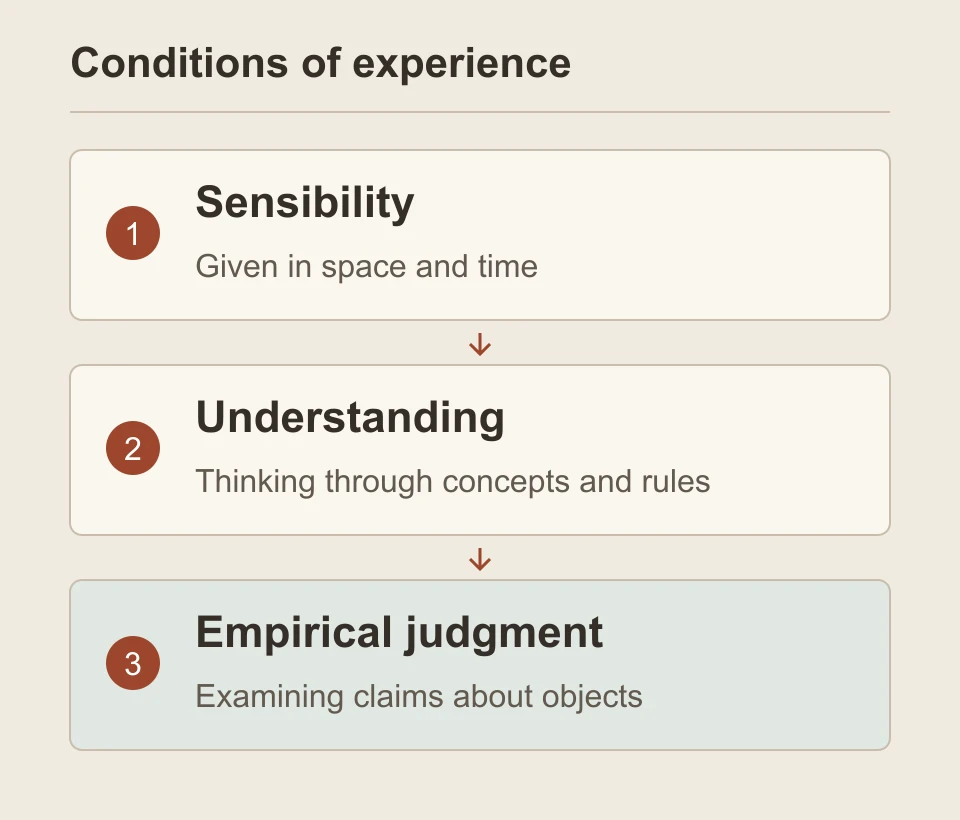
An original diagram distinguishing roles in cognition, not a biological or temporal sequence.
From conformity to objects to the conditions of cognition
The preface begins with the path of a science. Kant considers logic, mathematics, and natural science before asking why metaphysics has not secured a comparable path. Here, certainty is different from feeling confident. Inquiry needs reasons and methods that others can examine. Feeling that one has won a dispute is not equivalent to adding to a body of knowledge.
In the discussion of natural science, reason does more than passively receive accidental observations. Kant invokes Galileo and other investigators to emphasize that questions and plans precede experiments. Researchers decide which conditions to alter and what to compare. They do not thereby determine the answer in advance. Setting a question and discovering how nature responds are different activities; inquiry must remain answerable to the response.
Kant does not present these examples as a complete history of experimental method. A note in the preface limits their historical precision. Their philosophical role is to show the investigator's active contribution. The difference between accidentally collected observations and an experiment organized around a question matters more here than the scientists' names. The passage also distinguishes the work an explanatory analogy performs from the evidence required for a detailed history of science.
At B xvi, Kant proposes a change of hypothesis. Instead of assuming only that cognition must conform to objects, try asking whether objects of experience must conform to our way of cognizing. This does not refer to one person's favorite color or another person's preferred rumor. It concerns common conditions under which anything can be given to us and judged as an object. Space, time, and concepts will give this proposal more specific content in the next lesson.
Copernicus provides an analogy for changing the question. An explanation of observed motion can change when we consider the observer's position and movement, rather than assigning all movement to the observed objects. Kant is not proving epistemology through astronomy. He is suggesting that an obstructive assumption about subject and object can be reconsidered. An analogy can open an investigation without doing all the argumentative work that follows.
The distinction between a priori and empirical knowledge now matters. A priori does not simply mean that a completed stock of information was present in the mind before one's first experience. The question is whether a judgment's validity depends entirely on collecting particular experiences. Kant's introduction distinguishes knowledge beginning with experience from knowledge arising wholly out of experience. Confusing temporal beginnings with grounds of justification turns the a priori into either a mysterious power or a prejudice.
Repeatedly observing the same sequence is different from claiming that the connection must hold. Necessity does not automatically follow from a large number of observations. Kant asks about the grounds of judgments that claim universality and necessity. Before agreeing with his answer, identify the kind of question. Saying that something has always appeared so to me and saying that a condition is required for any possible experience are claims of different scope.
The proposed turn has a cost. Explaining how objects of experience can be known does not establish that things considered independently of those conditions are known in the same way. Grounding knowledge also sets its limits. Critique therefore aims to avoid both unlimited confidence and the abandonment of knowledge. Limitation is part of the project itself, not a consolation added after inquiry fails.
Distinguish a personal viewpoint from a condition of experience. Enjoying cold weather is a preference. Specifying a thermometer's scale, the time of measurement, and a comparable location makes observational conditions explicit. Kant's question reaches further: how can we experience something in space and time and judge it as one object at all? Everyday measurement is an analogy that helps introduce this question; it does not prove transcendental philosophy.
If objectivity means a viewpoint with no subject involved, Kant's turn can seem paradoxical. He instead investigates common cognitive conditions to explain objective experience. This is far from saying that every opinion has equal standing. Bad measurements and reliable observations, justified judgments and mistakes, still need to be distinguished. Do not jump from the presence of a subject in the explanation to the conclusion that everything is merely subjective.
Another distinction will concern analytic and synthetic judgments: clarifying what a concept already contains differs from connecting something further with it. Kant's project asks, in particular, how claims to extend knowledge without merely accumulating experiences can be justified. Before memorizing the terminology, learn to ask what new claim has been made and where its warrant is supposed to come from.
Three questions for critical philosophy
Identify the predicament
Ask why metaphysical disputes keep recurring.
Change the approach
Examine the conditions under which a subject experiences and judges objects.
Define the scope
Explain both objective experience and the limits of claims beyond it.
This map outlines the second-edition preface's project. It does not replace the arguments of the Aesthetic and Analytic.
Avoiding wishful thinking and relativism
Do not translate the claim that cognition contributes to the constitution of objects of experience into the claim that wishes produce external events. Kant is investigating the conditions of experience and knowledge. Nothing here justifies the suggestion that intensely imagining success will bring success about. This is an essential boundary when adapting his philosophy into contemporary advice.
Nor does the phrase Copernican turn require us to accept Kant's conclusions. What exactly are the conditions of experience? Are they common to all human knowers? Has their necessity been adequately argued? These remain questions for further examination. The first lesson succeeds by clarifying what needs proof, rather than making the questions disappear.
Fictional case: two thermometers in one room
The following museum scene is an editorial invention. Educator Eunseo pauses when two thermometers intended to show the temperature of the same room disagree. One visitor jokes that this proves everyone has a different truth. An organizer suggests leaving only the higher number on the screen for a cleaner presentation. Eunseo notices the growing queue too. But which value suits the presentation differs from what was measured. Sunlight reaches the instrument by the window, while the other stands in shade.
Eunseo places both instruments together in the shade and allows time for them to settle. Their readings move closer, but that does not make the original difference simply false. If the question concerned conditions by the window and in the shade, that difference might itself matter. Comparing the instruments under the same conditions instead gives a reason to align place and time. The observer emerges as someone who structures a comparison around a question and makes its conditions public, rather than choosing a number by preference.
A visitor asks whether this means the experimenter decided the truth. Eunseo chose the question and method, but not the values the instruments would show. Had they continued to disagree, the equipment or method would have needed further investigation. The scene distinguishes actively asking from inventing an answer. A thermometer's location is a condition that can be changed within experience. Kant's account of space, time, and understanding concerns the possibility of experience in general; this afternoon's measurements do not establish the necessity of those conditions.
Eunseo drops the planned line about the viewer creating the world. For visitors expecting a magical revelation, the ending may seem subdued. Yet different numbers need not license every interpretation, nor require erasing the observer's contribution. The display will show the comparison's conditions and its actual results. A deeper question now follows: how does receiving these values differ from connecting them in a judgment about an object? The next lesson approaches that difference through the roles of sensibility and understanding.
Facts, concepts, and application
- 01
Critique and rejection: discarding every claim of reason differs from examining the conditions of its legitimate use. Kant's project seeks both the possibility and the limits of knowledge through the latter.
- 02
Beginnings and grounds: when you first learned something and why the resulting judgment is valid are different questions. Do not understand the a priori solely as a claim about your earliest memories.
- 03
Analogy and proof: the thermometer case illustrates the observer's contribution, but does not establish the a priori status of space and time. A separate philosophical argument remains beyond what the empirical example explains.
Where to check the argument
This is an English localization of our original Korean lesson. Source arguments, editorial interpretation, and fictional applications are distinguished; no dialogue is presented as Kant speaking to a contemporary reader.
Read the sections and editions identified below alongside the explanation. AA refers to the Academy edition's volume and page; A/B identifies the two editions of the Critique of Pure Reason.
Independent reference: Stanford Encyclopedia of Philosophy: Immanuel Kant ↗