
The principle behind a choice
Section II of the Groundwork asks whether the supreme moral principle can be derived from investigating what people happen to desire. Even a widely shared desire may fail to bind someone who lacks it. Kant seeks the grounds of a moral demand that does not depend on particular tastes or interests. This is why classifying imperatives takes priority over compiling a list of human wants.
A maxim is a subjective principle an agent follows in acting. Subjective here does not mean groundless; it means adopted by this agent as a basis of choice. A moral law claims objective validity for rational beings generally. Possessing a maxim does not make it a law. That gap is precisely what calls for examination.
This lesson studies the distinctions at AA 4:412–420 and prepares for the formula of universal law. Separating circumstances, action, and purpose is an editorial way of explaining what a maxim reveals. It can bring into view the action and reason obscured by the assertion that a purpose was good.
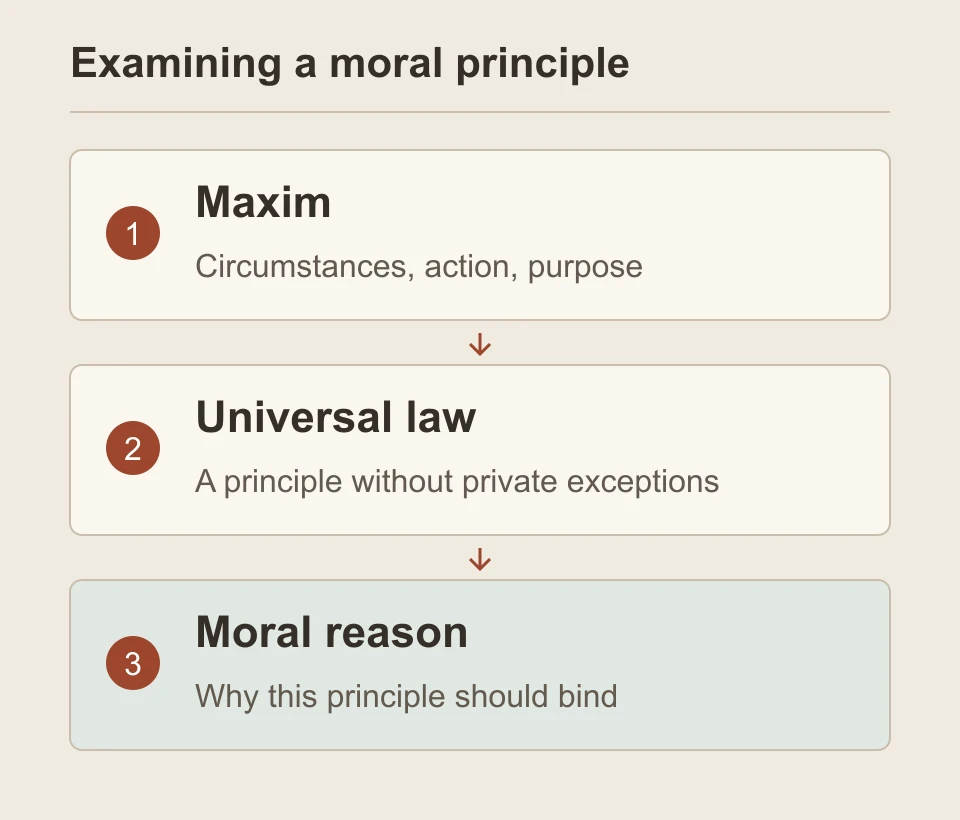
An original conceptual diagram. It does not calculate moral worth from outcomes alone.
Rules of skill, counsels of happiness, and moral commands
If a will were completely determined by reason, knowing what is right and choosing it would not diverge. Human desire, fear, and habit can interfere. Rational principles therefore appear to us as requirements: things we ought to do. Kant calls this form of requirement an imperative. The term is not limited to a superior raising a voice to issue an order.
A hypothetical imperative connects willing an end with willing the necessary means. To play an instrument, practice; to build a strong shelf, examine materials and structure. Someone who does not want the end is not thereby given the same reason to choose those means. Conditional dependence is the point, not weakness or triviality. Given the end, the requirement concerning means can be very demanding.
Rules of skill concern how a goal can be achieved. Skill, however, does not guarantee that the goal is morally justified. Someone may be highly effective at deceiving others if effectiveness alone is the standard. The Groundwork separates morality from technique to make this difference visible. An evaluation of doing well needs to specify what is being done well.
Counsels concerning happiness are more complicated. Even if everyone desires happiness, it is difficult to determine fully what will ultimately secure it. Wealth, knowledge, or a long life may bring unexpected burdens under actual conditions. Kant examines the indeterminacy of the empirical elements that give happiness its content. Desiring happiness alone cannot provide a certain rule for every situation.
This does not make practical wisdom about happiness worthless. Useful advice remains possible, but its status differs from moral law. Whether a choice will make me happy calls for experience and attention to circumstances. Reducing every moral demand to a strategy for personal happiness leaves unexplained why the obligation remains for someone who gains no advantage.
A categorical imperative does not require an action only as a means to some further end. Avoiding wrongdoing because it may damage one's reputation differs from rejecting it even when one's reputation is secure. A moral demand claims unconditional validity in the latter sense. Unconditional does not mean repeating the same bodily movement regardless of facts. It means that the ground of obligation is not dependent on my contingent purposes.
The surface grammar of a command is insufficient. An emphatic demand to practice may depend on wanting musical proficiency. A gently phrased demand not to promise deceptively in difficult circumstances can mention a condition without becoming hypothetical in Kant's sense. Conditions specifying when an action occurs differ from an end on which obligation depends. Counting instances of the word if cannot classify an imperative.
Return now to maxims. Returning money because discovery would be inconvenient differs from returning it because it belongs to the person who entrusted it. The visible act alone does not reveal the difference. The maxim includes why the agent chooses that act in that situation. Universalization in the next lesson examines this principle, rather than copying an action's name indiscriminately into every circumstance.
A maxim stated too broadly loses its object of assessment. Saying that I act for happiness does not show what I do, how, or to whom. Conversely, adding my exact name and date to make a rule possible only once can hide a personal exception. Preserve morally relevant circumstances and purposes without using accidental details as an escape route. Describing a maxim honestly is substantive intellectual work.
A maxim is also not the noblest advertising slogan attached after an action. If fear of loss actually determined a choice, describing it as pure respect for everyone conceals rather than examines the principle. Reasons may be mixed, and we should ask which influenced the decision. Perfect self-knowledge is not required, but we can ask whether we would follow the same principle if conditions changed.
A change of conditions can reveal the character of a maxim. What if nobody were watching, no reward were offered, or the recipient were not a friend? Such questions do not automatically produce a correct moral answer. They can reveal whether an allegedly universal reason actually depends on a particular reward. First clarify the maxim's structure; then assess whether it can be recognized for anyone in the relevant situation.
A maxim may differ from a rule someone professes. If I call myself fair but repeatedly take exceptions that favor my own interests, I need to identify the principle explaining that pattern. The gap between words and choices gives universalization a more accurate principle to assess.
Three questions that reveal a maxim
In what circumstances?
Identify the conditions relevant to judging the choice.
What is done?
Abstract praise can obscure what action actually takes place.
For what reason?
Examine the purpose and the grounds for choosing the action.
These editorial questions explain the content of a maxim. The same conduct can reveal different principles depending on its circumstances and purpose.
Conviction is not the same as validity
Do not identify the categorical imperative with certainty or strength of resolve. Feeling absolutely determined differs from having a principle valid for everyone. An enthusiastic, consistent agent may still claim an exception unavailable to others. The force of a resolution does not justify a moral law.
Nor is a hypothetical imperative inherently immoral. Practicing to learn cooking or coordinating schedules to meet a friend are necessary forms of means-end reasoning. The distinction does not abolish technique or advice about happiness. It prevents us from assuming that these alone explain the ground of moral obligation.
Fictional case: choir rehearsal and financial transparency
This fictional choir is an editorial invention. Before a performance, Jiho calls for extra rehearsal while the treasurer asks for an explanation of membership spending. Both proposals concern preparation, but their reasons differ. Rehearsal is a means to singing well together; an honest account of entrusted funds has a claim that is not exhausted by the concert's success. Even canceling the performance would leave the spending to be explained. The difference concerns the ground of a requirement, not how forcefully either person speaks.
The accounts include a cancellation charge Jiho incurred when changing venues. He proposes leaving it out just this once: a disappointed sponsor might reduce rehearsal-room support and harm the whole choir. The treasurer does not deny that forecast. Instead, she points out that using it to justify omission makes honesty conditional on benefiting the group. Beneath the phrase protecting the choir lies a more specific action: hiding unfavorable spending to influence someone else's judgment. A flattering description had obscured the principle being adopted.
Jiho explains the charge and his reasons for changing venues. The sponsor reduces further support, and some members point out that reporting honestly does not make the original decision sound. Honesty does not automatically erase a management mistake. Conversely, an unfavorable outcome does not remove the reason to explain. The case does not adjudicate accounting regulations; it distinguishes a principle followed only when a desired end is served from a requirement that remains without that reward.
With less support, the choir rearranges its rehearsals. Finding effective means to improve the performance remains necessary; calling such reasoning hypothetical does not make it immoral. But usefulness to a good performance cannot authorize every means. When Jiho promises to explain unfavorable facts in future, the decisive issue is his basis for choice rather than the firmness of the sentence. The next lesson asks whether that maxim can be recognized for everyone without preserving a personal exception.
Facts, concepts, and application
- 01
Two senses of condition: circumstances in which action occurs differ from dependence of an obligation on a chosen end. Mentioning circumstances does not automatically make an imperative hypothetical.
- 02
Maxim and law: the principle I actually adopt differs from a principle claiming validity for everyone. Keep this gap visible to begin moral examination.
- 03
Skill and morality: effectiveness in achieving a purpose differs from the justification of that purpose and its means. Competence alone does not establish rightness.
Where to check the argument
This is an English localization of our original Korean lesson. Source arguments, editorial interpretation, and fictional applications are distinguished; no dialogue is presented as Kant speaking to a contemporary reader.
Read the sections and editions identified below alongside the explanation. AA refers to the Academy edition's volume and page; A/B identifies the two editions of the Critique of Pure Reason.
Independent reference: Stanford Encyclopedia of Philosophy: Immanuel Kant ↗