How the grounds of knowledge establish its limits
The previous lesson examined the contribution of space, time, and concepts to experience. We now ask whether removing those conditions leaves us able to know an object in the same way. The Analytic of the Critique of Pure Reason explains the possibility of experience while defining the scope of that explanation. This boundary helps us understand what goes wrong in the Dialectic that follows.
The relationship between appearances and things in themselves is disputed in Kant scholarship. A reading involving two worlds and a reading involving two aspects of the same objects cannot simply be treated as one settled interpretation. This introduction centers on a distinction both interpretations must address: knowing objects under the conditions of experience differs from claiming knowledge independently of those conditions.
We again use the A/B pagination of the two editions. The discussion of phenomena and noumena begins at A235/B294; the antinomies belong to the Transcendental Dialectic. This lesson is not a list of every criticism Kant makes of theology or theories of the soul. It asks when an unanswered question reflects a temporary lack of evidence, and when a claim exceeds the scope of the concepts being used.
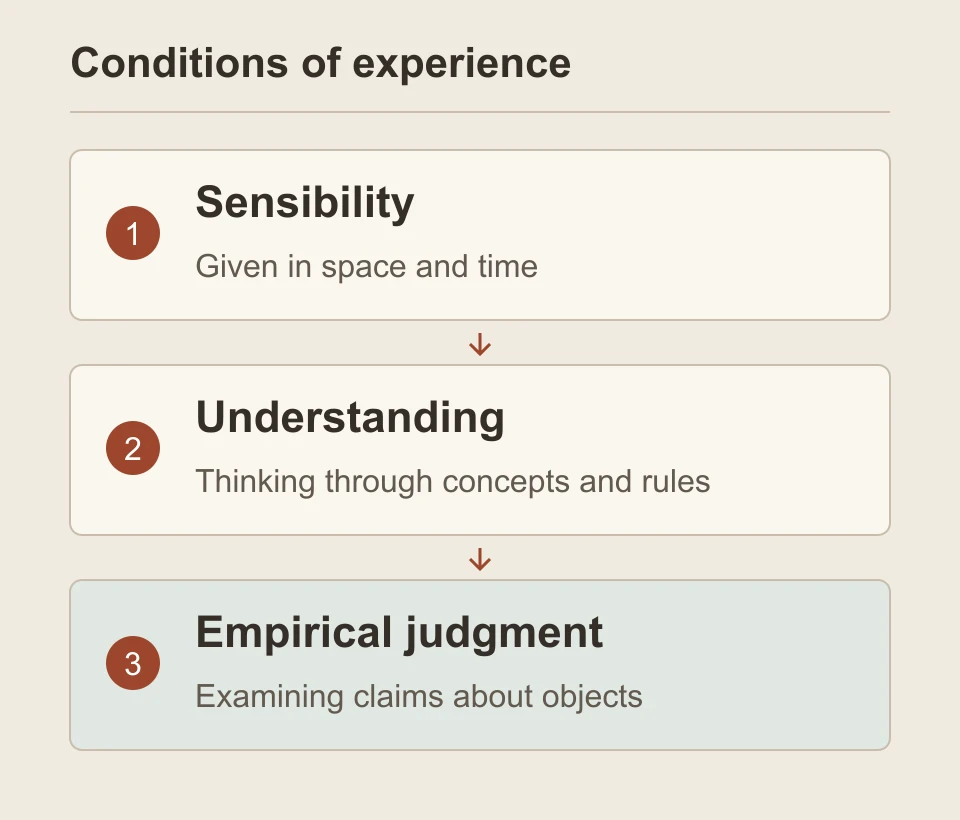
An original diagram distinguishing roles in cognition, not a biological or temporal sequence.
Appearances, things in themselves, antinomies, and ideas
An appearance differs from an image invented at will. The location of a cup or the temperature of its water can be investigated and checked with others within experience. Calling the cup an appearance does not allow us to place it wherever we like. Questions of truth and falsity within experience remain. The central task is to maintain both empirical objectivity and the limits associated with its conditions.
Errors can occur within that very field. We may misidentify a distant object or connect events to the wrong cause. Closer observation and comparison of evidence may correct the mistake. Being an appearance, however, is not a low-accuracy stage that more observations eventually overcome. Accurate observations also operate under human cognitive conditions. Equating appearance with illusion destroys the point of improving knowledge through verification.
A thing in itself enters the discussion when a thing is considered independently of those conditions. The distinction prevents us from automatically treating the conditions of our cognition as the conditions of all existence. Yet it does not give positive knowledge of the properties of things in themselves. Marking a boundary differs from possessing a map of the territory beyond it. Ask what a limiting concept actually limits.
Kant also distinguishes negative and positive senses of noumenon. We can negatively consider something as not an object of sensible intuition, without claiming to know it through a nonsensible intuition. We cannot assume that human beings possess such intellectual intuition. There is a substantial gap between refusing to make sensible cognition the measure of all existence and claiming direct knowledge of what lies outside sensible cognition.
Why does reason keep crossing the boundary? Having found a condition of an event, we ask for the condition of that condition. Looking further for causes and greater explanatory unity matters to inquiry. The problem changes when the entire series of conditions is treated as a completed object already known. Guiding continued investigation differs from assuming that a totality beyond experience has been given.
The antinomies reveal this problem. The first opposition concerns arguments that the world has a beginning in time and that it has no beginning. Rather than merely choosing an answer to an old cosmological dispute, examine what both arguments presuppose. Can the world containing the totality of experiential conditions be treated as if it were one more object of possible experience?
Kant's response is not a compromise selecting half of each conclusion. He examines the assumption generating the conflict: concepts used for objects of experience have been extended without qualification beyond experience as a whole. Investigating earlier events within experience differs from possessing the endpoint of all time as an object. Nor should this argument be applied directly to particular hypotheses in modern cosmology as a reason to prohibit research.
The third antinomy, concerning freedom and natural causality, opens a route toward later moral questions. Events within experience admit explanations through natural laws. Kant asks whether this eliminates every possibility of thinking freedom. He has not thereby discovered freedom scientifically. Clarifying the scope of natural explanation leaves room to examine a practical standpoint. Lesson nine returns to this distinction.
Ideas of reason are not therefore useless thoughts to be discarded. They can direct inquiry toward greater unity and more comprehensive grounds. This is their regulative use. Treating them instead as principles that constitute knowledge of objects beyond experience exceeds their authority. Distinguishing these uses lets us search for a better system while acknowledging that inquiry is unfinished.
Limits of knowledge can thus be understood as demands to identify the kind of claim being made, rather than commands to stop asking questions. Thinking something, believing it, and knowing it empirically involve different grounds. Ignoring the distinction can lead either to filling gaps with imagination or to doubting well-supported findings. Critique asks for reasons appropriate to a claim and permits inquiry within its proper scope to continue.
In everyday life, the language of limits can become a defense against listening. Yet difficulty knowing another person's intentions is not simply the same problem as the thing in itself. Interviews and observations may improve an empirical judgment about motives. Instead of applying a philosophical term to every difficult object, separate questions that further evidence can clarify from claims that exceed the conditions of possible experience.
Accepting a boundary of experience need not diminish curiosity. If you can specify observations that would change a conclusion, the question remains open to investigation. Learning about limits should not merely reduce the number of questions asked. It should make us more precise about the evidence a question calls for.
Three questions about the scope of a claim
Judge within experience
Test observations and explanations against evidence.
Identify the boundary
Ask whether objects independent of those conditions can be known in the same way.
Distinguish uses of reason
Separate ideas guiding inquiry from knowledge of an object.
This diagram does not settle every scholarly dispute about appearances and things in themselves.
Ignorance does not authorize every claim
Not knowing things in themselves does not prove the existence of a mysterious power. Pointing to a limit of knowledge does not make a particular story beyond that limit true. Neither does it turn verifiable facts into matters of personal taste. A claim of ignorance needs a definite object and scope.
Do not map an antinomy directly onto a contemporary scientific disagreement. The unconditioned totality of experience at issue for Kant differs in role from scientific theories competing on the basis of observational evidence. Understand the classical argument first, then separately assess its relationship to modern theories. A difficult term is no reason to stop investigating.
Fictional case: explaining a diary's silence
This historical exhibition is an editorially invented case. Harin reads a traveler's diary recording only weather and prices on the day of a major fire. Other records support the date and the region visited around that time, but do not explain the omission. A video producer proposes a mystery about the secret behind the silence. Another colleague says an inner life is a thing in itself and therefore impossible to investigate. One response fills the gap with a motive; the other closes the possibility of inquiry.
Harin searches letter catalogs and newspapers from the period. The reason for silence is a historical question currently lacking sufficient evidence. Because new material could alter the explanation, it differs from claiming knowledge of things independently of human cognitive conditions. The diary's omission is established, but whether the traveler was unaware, considered the fire unimportant, or recorded it elsewhere remains unsettled. Being able to imagine several explanations does not establish that any particular one is true.
A newly located letter says the traveler heard about the fire several days afterward. Relieved, the producer thinks suspicion of indifference can now be dismissed entirely. Harin notes that the letter's timing and transmission also need examination. It supports an account of learning later, without revealing every thought the traveler had. Investigation has not left them knowing nothing. One explanation previously considered merely possible has acquired better support, and the range of what remains unexplained has narrowed.
Instead of a protagonist hiding a secret, the display places surviving records alongside the newly found letter. There is less dramatic revelation, but visitors can see why the explanation changed. The whole history of the fire has not been established, nor does its importance depend on this traveler's silence. The scene concerns sustained attention to empirical uncertainty, not an encounter with a thing in itself. Having examined the grounds and scope of knowledge in the first three lessons, the course now turns to reasons for action. Even without certainty about outcomes, the will with which someone acts remains a distinct question.
Facts, concepts, and application
- 01
Appearance and illusion: an object given under cognitive conditions differs from a mistaken judgment about that object. Truth and falsity can be distinguished within appearances.
- 02
Thinking and knowing: being able to think a concept without contradiction does not by itself establish knowledge of its object's properties. Grounds for cognition are still required.
- 03
Regulative direction and knowledge of an object: a principle guiding inquiry toward unity should not be converted into knowledge of a completed object beyond experience.
Where to check the argument
This is an English localization of our original Korean lesson. Source arguments, editorial interpretation, and fictional applications are distinguished; no dialogue is presented as Kant speaking to a contemporary reader.
Read the sections and editions identified below alongside the explanation. AA refers to the Academy edition's volume and page; A/B identifies the two editions of the Critique of Pure Reason.
Independent reference: Stanford Encyclopedia of Philosophy: Immanuel Kant ↗