
Connecting universal law and humanity through autonomy
The later part of Section II, AA 4:431–440, connects universal law and humanity through autonomy. Explaining duty solely by external rewards or punishments makes its ground unstable when those incentives disappear. Kant argues that a rational being must be understood as giving law, rather than merely receiving it.
In everyday usage, autonomy may mean independent authority at work, room to choose, or not depending on others. These conditions matter, but are not identical to Kant's autonomy of the will. An unopposed choice can still treat desire or reward as its ultimate ground. Conversely, following a common rule does not necessarily eliminate autonomy.
The kingdom of ends is not a historical state or a named political system. It is an idea of rational beings recognizing one another as ends under common laws. The shared-studio case below is invented to explore that relationship. Majority approval alone does not make any chosen rule Kantian.
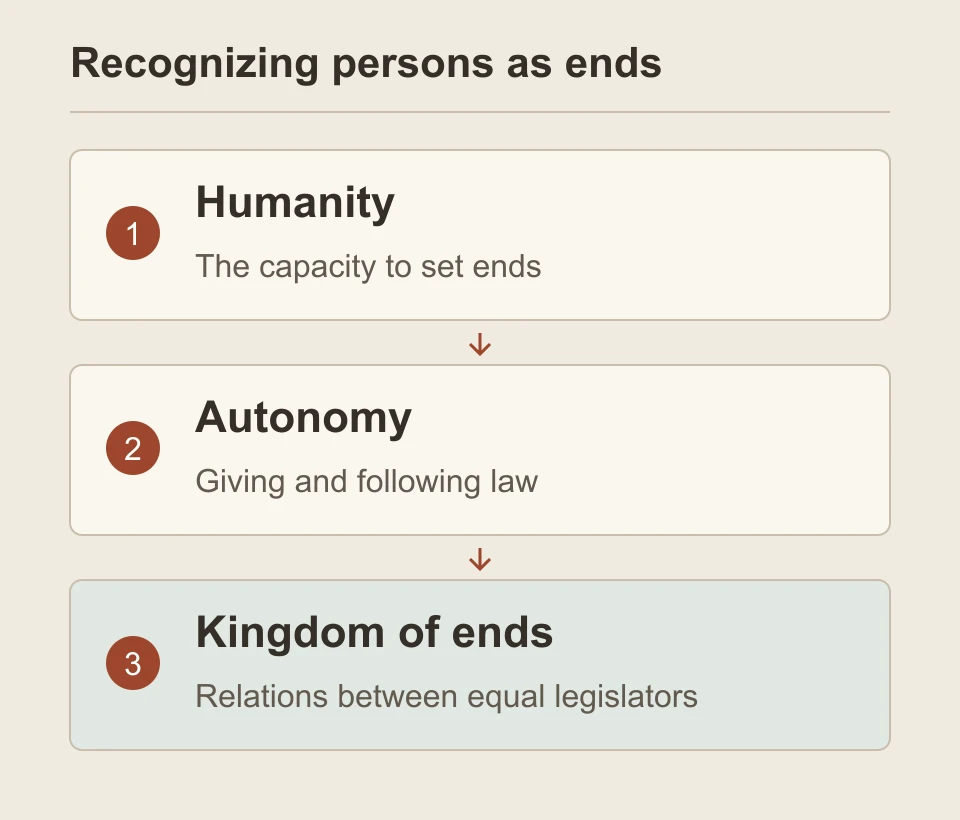
An original diagram linking humanity, autonomy, and the kingdom of ends. It depicts neither an actual state nor two separate worlds.
Giving and following law in a kingdom of ends
The argument about autonomy asks where moral obligation is grounded. If I am honest to avoid punishment, the determining reason depends on an external outcome. Praise, happiness, and rewards can occupy the same place. Kant asks whether the will can be determined by a principle's validity, rather than merely by its usefulness in obtaining a desired result.
Heteronomy does not simply mean that another person issued the instruction. I may follow my preferred desire without interference, yet remain heteronomous in Kant's sense if its object supplies the ultimate determining principle. Saying that I wanted an action identifies the chooser, but not the character of its justification. Autonomy concerns the ground of the principle, rather than just the psychological source of the choice.
Giving law to oneself is not inventing any rule whatsoever. The law of a rational will must be universal. Invoking principles to restrict others while claiming convenient exceptions for oneself cannot be sustained as autonomous legislation. Read the activity of giving law together with the constraint of standing under that same law. Removing either turns autonomy into arbitrary assertion or mere obedience.
The kingdom of ends develops this relationship. Each rational being is an end in itself and is considered a legislator of principles to be recognized with others. The kingdom does not mean that all private wishes actually merge into one. It asks at the level of principle how different purposes can coexist. Abstracting from private differences does not require erasing real differences between people.
A member both gives law and is subject to it. Someone imposing a rule that does not apply to themselves undermines the relation of equal legislators. Kant distinguishes the idea of a wholly independent sovereign from finite members. Ordinary human beings do not thereby acquire a right to declare their private will the law for everyone. We read from the standpoint of members who must explain principles to one another.
The distinction between price and dignity concerns substitutability. Something with a price can be replaced by an equivalent. Skills providing a service may have a market price. But the status of a rational being capable of giving and following moral law is not a value exchangeable for an equivalent object. Dignity is therefore not an especially high price.
Higher wages or greater talent do not confer more dignity. A decline in marketable capacities does not justify less respect. Economic assessment may have a legitimate place without determining the whole moral status of a person. Negotiating a price and deciding how a person must be treated are related but different evaluations.
Autonomy is connected to dignity because the person is understood as capable of relating to self and others under law, rather than merely as an object satisfying desires. Dignity differs from the pleasant experience of a good reputation. It names a standing to be recognized even without applause or self-satisfaction. Changes in self-esteem cannot fully explain it.
The kingdom of ends is not a bargain under which I have duties only while everyone else behaves well. Kant maintains that the law's demand remains without a guarantee that others will comply or that nature will reward virtue with happiness. A transaction of respecting someone only after they respect me does not explain the moral reason. This does not require abandoning legitimate self-protection or responses to wrongdoing.
Distinguish an ideal from a realized community. Declaring that an institution already constitutes a perfect kingdom of ends can eliminate the standard by which it should be criticized. The idea can assess decisions and institutions, but does not certify existing agreement as a complete moral order. If a member is excluded as an equal judge, exposing that defect is part of its critical role.
The three concepts can be connected in one account. Autonomy concerns determining the will through universal principle rather than merely approval or reward. Dignity concerns recognizing one another as ends capable of such legislation. The kingdom of ends considers this relationship systematically. They address a connected moral problem at different levels, rather than naming a mood, a market evaluation, or an actual state.
A person can negotiate compensation without negotiating their dignity. Duties of honest explanation and respect for choice do not decrease in proportion to wages, even though compensation may vary by role and work. Explaining this distinction in actual relationships keeps price and dignity from becoming abstract expressions of praise.
From an individual principle to common law
Autonomy
Examine principles without treating contingent rewards as their ultimate ground.
Dignity
Recognize persons as ends beyond replaceable achievements.
Kingdom of ends
Consider members who give law and stand under the same law.
This is neither a blueprint for an actual government nor a guarantee that every agreement is justified.
Autonomy is not isolation or majority approval
Do not equate autonomy with isolation or self-sufficiency. People can depend on education, assistance, and institutions while examining the grounds of principles for themselves. Kant's account does not immediately imply that all help must be refused. Separate social independence from the justification of moral principles.
Majority agreement is not a sufficient ground for universal law. Most members might approve an exception disadvantaging only a minority. The question is whether everyone affected is recognized as an equal end, and whether the same principle can apply to those making it. Participation procedures and the content of principles both require examination.
Fictional case: priority in a shared studio
In this editorially invented shared studio, classes taught by popular members cover a substantial share of running costs. Managers propose giving those members priority for evening slots, and most agree. Subin, who works elsewhere during the day, does not deny their financial contribution. She explains that the remaining hours would effectively prevent her from using the studio. Assessing income has become a question about the place given to different members' activities and judgment.
Review reveals that managers always retain priority regardless of their contribution to income. Maintenance may require reserved time, but no reason has been given for extending the same protection to their private projects. The rule's makers stand automatically outside it. Winning a vote, or choosing a rule willingly, does not by itself establish autonomy in Kant's sense. Giving law to oneself also involves being bound by its principle.
Identically dividing every hour would not settle the issue either. Equipment requiring long preparation and fixed teaching schedules may justify different allocations. Rather than demanding the removal of every popular teacher's slot, Subin asks the group to consider usable member hours alongside preparation needs. Distinguishing popularity or payment from dignity does not require giving every service the same price. The issue is which differences can justify an allocation, without turning financial usefulness into a hierarchy of personal standing.
Managers' private bookings now undergo the same review, and some evening hours are reserved for members. A teacher moves classes elsewhere, reducing income and opening another debate about higher fees or a smaller operation. Equal respect does not generate running costs. The revised allocation remains open to criticism; it is not proof that a kingdom of ends has been achieved. The next lesson considers how an agent seeking to follow principles can also be affected by desires and environment, through the two standpoints on freedom.
Facts, concepts, and application
- 01
Autonomy and arbitrariness: giving oneself universal law differs from allowing anything because one wants it. Self-legislation includes being bound by the law oneself.
- 02
Price and dignity: the exchange value of a performance differs from a person's standing as an end. Dignity is not measured by market demand.
- 03
Ideal and accomplished institution: using the kingdom of ends as a standard differs from declaring that an existing community has realized it.
Where to check the argument
This is an English localization of our original Korean lesson. Source arguments, editorial interpretation, and fictional applications are distinguished; no dialogue is presented as Kant speaking to a contemporary reader.
Read the sections and editions identified below alongside the explanation. AA refers to the Academy edition's volume and page; A/B identifies the two editions of the Critique of Pure Reason.
Independent reference: Stanford Encyclopedia of Philosophy: Immanuel Kant ↗