The harder question in Section III
The earlier lessons examined the character of moral principles. Section III asks the harder question of why they bind us. Adding the word freedom does not settle it. If morality is explained through freedom and freedom is assumed because of morality, the reasoning may be circular. Kant explicitly acknowledges this suspicion.
Our focus is AA 4:446–463. We do not merge the Critique of Practical Reason's account of the fact of reason or every later debate about freedom into the Groundwork's argument. Kant's justificatory approach develops across his works. Here we follow Section III's standpoint of freedom and its remaining difficulties without concealing them.
Freedom has several senses. An unlocked exit, a choice without coercion, and a will giving itself principles are related but not identical. Investigating the options actually available in daily life matters. Doing so, however, does not automatically resolve the Groundwork's question about the grounds of freedom and morality.
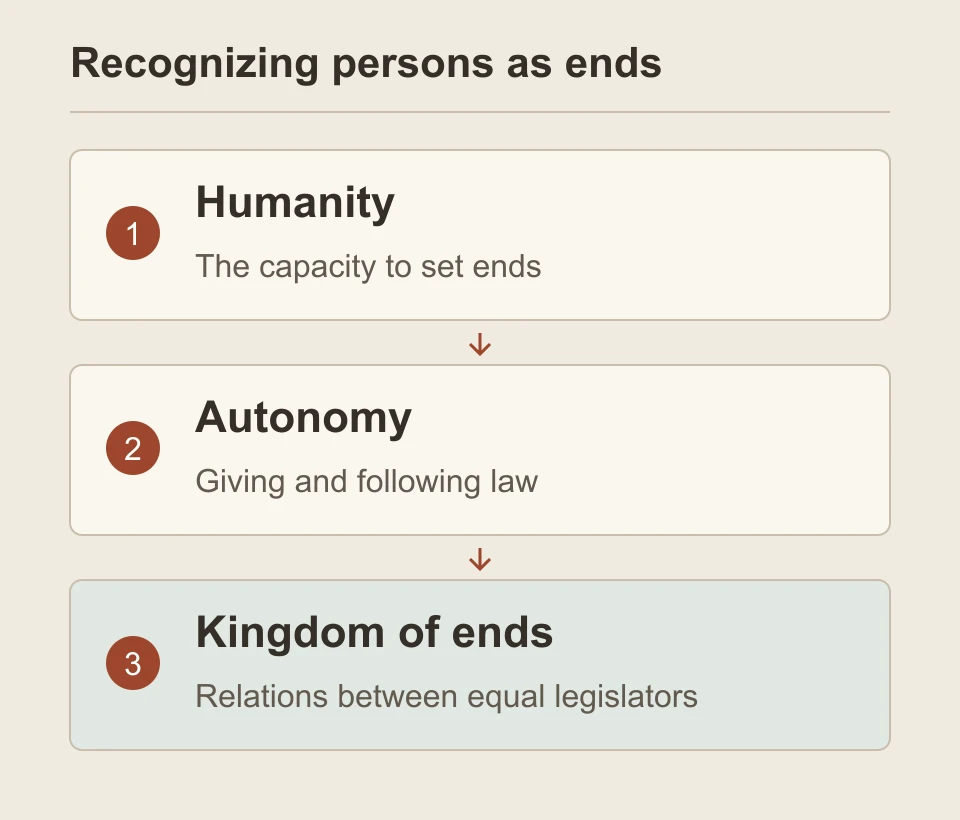
An original diagram linking humanity, autonomy, and the kingdom of ends. It depicts neither an actual state nor two separate worlds.
The idea of freedom and two standpoints on oneself
Section III describes will as a kind of causality belonging to rational beings. Freedom negatively understood is independence of this causality from external determining causes. But saying what it is independent of does not adequately explain how it acts. Random or entirely lawless movement would obscure rather than explain a responsible will.
Kant does not identify freedom with lawlessness. Without a law of its own, a will's activity would be difficult to understand as action for reasons. A positive conception of freedom leads to autonomy, giving law to oneself. This is why the previous lesson separated autonomy from arbitrary preference. Independence and the principle of self-determination must be explained together.
A deliberating agent cannot simply treat a judgment of what is right as an impulse arriving from outside. Assessing a reason's validity presupposes the agent's participation in judging. Kant says that a rational being with a will acts under the idea of freedom. This is an argument about practical judgment, rather than an experiment discovering freedom as an object.
The difference between theoretical proof and practical presupposition now matters. We cannot explain freedom's operation through a list of empirical causes. Yet deliberating about what ought to be done is not exhausted by observing which impulse is strongest. Kant asks about the conditions under which a rational will must consider itself the author of principles. The thought performs a different explanatory role.
The suspicion of circularity remains: if we obey moral law because we are free, and regard ourselves as free because we ought to obey moral law, each may merely presuppose the other. Kant distinguishes showing a relationship between concepts from justifying their validity. A diagram connecting freedom, autonomy, and morality cannot finish the argument.
His proposed route distinguishes two standpoints on oneself. As a member of the sensible world, one's action is an event in time, explained through natural laws and influences. From the intelligible standpoint, one considers oneself a rational agent giving principles. This is not a picture of a small free person living beside a visible body. It changes the relation under which the same self is considered.
The earlier distinction between appearances and things in themselves reappears. Does the self observed under experiential conditions exhaust every standpoint from which it can be thought? The answer does not supply positive knowledge of what an intelligible self looks like. Kant maintains that this standpoint has a role different from information about natural conditions. We should not fill the unknown with an imagined map.
Why does morality appear as an ought for human beings? We can think principles while also being affected by desire and inclination. The tension between rational willing and actual choice gives obligation its form. Describing the deliberating self as pure spirit wholly outside natural conditions would remove this very tension. The two standpoints attempt to account for a complex human position.
Explaining a natural cause and giving a justifying reason answer different questions. Fatigue and pressure can help explain harsh speech. Whether that speech was right requires further reasons that could be offered to its recipient. This does not put causes and reasons into utterly disconnected worlds, but it distinguishes explanatory tasks.
This distinction does not command us to ignore environments. Actual opportunities, coercion, information, and capacities matter when assessing responsibility. Invoking freedom to assume that everyone can act identically under every condition erases empirical facts. Our contemporary case illustrates how causal explanation does not exhaust moral assessment; it does not prove metaphysical freedom.
The Groundwork ends without claiming complete understanding of how freedom is possible. There are limits to explaining how pure reason can be practical. Trying to explain freedom as an empirical cause may frustrate the purpose of that explanation. Acknowledging the boundary is not decorative concealment of a difficulty. It lets readers preserve both the argument's intended achievement and what remains hard to understand.
Kant seeks neither freedom purchased by rejecting science nor responsibility established by erasing environmental influences. He tries to make room for the practical agent to think under the idea of freedom while retaining natural explanation. Whether that construction is fully persuasive remains a philosophical dispute. The different roles of causal explanation and reasons justifying principles reveal the tension his account addresses.
Two questions for the same agent
Natural standpoint
Explain the conditions and causes under which an action occurred.
Practical standpoint
Ask which principles the agent recognizes as reasons for choice.
Argumentative limit
Separate presupposing freedom practically from theoretically knowing how it works.
This concerns relations under which one subject is considered, rather than two people or two objects.
Preserve natural explanations and actual conditions of choice
Do not turn the two standpoints into two personalities. A bad body bound by nature alternating with a good soul immune from responsibility distorts the argument. The question concerns one agent considered in different relations; it is not a device for erasing actual consequences or responsibility.
Do not use the idea of freedom as a shortcut to medical or legal assessments of responsibility. Concrete judgments about a person's condition and options require evidence and appropriate disciplinary standards. Understanding a philosophical argument differs from adjudicating an individual case. Preserving this distinction prevents freedom from becoming a slogan for blaming others.
Fictional case: an insult and apology under deadline pressure
In this editorially invented publishing team, Hyunwoo sends an insulting reply to a colleague who identifies an error shortly before deadline. The next day he explains that an all-night shift and growing workload made him irritable. The colleague accepts that those conditions existed while distinguishing them from a reason to belittle the person raising the error. Investigating what caused the message and endorsing it as a justified choice require different kinds of explanation.
The manager says the schedule need not change because Hyunwoo chose his own words. This time the colleague objects: repeated apologies will not address a workload structure that encourages recurring conflict. They need not choose between declaring Hyunwoo wholly unaccountable and treating the environment as irrelevant. What influenced the action and which principle the agent recognizes as a reason in that situation remain questions together.
Hyunwoo separates the fact of having been corrected from the insult and apologizes. The colleague asks to work with another reviewer for a while. An apology does not confer a right to immediate forgiveness. Hyunwoo proposes a procedure for hearing objections, but proposing it alone cannot restore trust. The scene shows someone considering reasons for future choice instead of only observing past behavior as an event. It does not experimentally establish how metaphysical freedom operates.
The team removes some material from the issue to allow review time and redistributes work. Neither the insult already sent nor the loss of omitted material disappears, and collaboration cannot be declared fully restored. Changing natural conditions and taking responsibility for reasons are not completed by either measure alone. The next lesson moves beyond private reflection to reasons exposed to others' examination, through Kant's account of enlightenment and public reason.
Facts, concepts, and application
- 01
Negative and positive freedom: distinguish independence from external determining causes from autonomy, while explaining their connection. Do not reduce freedom to randomness.
- 02
Cause and justification: explaining the conditions producing behavior differs from giving reasons to endorse its principle. Neither task automatically eliminates the other.
- 03
Two standpoints and two objects: distinguish oneself as a natural event's agent from oneself considered as a rational agent. Do not describe an entity outside experience as if it had been observed.
Where to check the argument
This is an English localization of our original Korean lesson. Source arguments, editorial interpretation, and fictional applications are distinguished; no dialogue is presented as Kant speaking to a contemporary reader.
Read the sections and editions identified below alongside the explanation. AA refers to the Academy edition's volume and page; A/B identifies the two editions of the Critique of Pure Reason.
Independent reference: Stanford Encyclopedia of Philosophy: Immanuel Kant ↗