Connect the works while preserving their questions
This is not a reconstruction of an event Kant assessed. The Critique of Pure Reason examines experience and cognitive limits; the Groundwork examines principles of moral action; the enlightenment essay addresses freedom of public argument. How to present an unverified record and what place to give a resident's choice are connected but distinct questions. Preserving each work's question keeps philosophy from collapsing into one piece of advice about acting carefully with a good heart.
Nor are relations of right among states in Perpetual Peace converted into museum management rules: authority and scale differ. The preceding distinction between goodwill and enduring public relationships offers a limited comparison here. A staff member's personal promise of respect differs from procedures that preserve explanations of use after that person leaves. This connection is an editorial application, not a museum policy Kant supplied.
The alternatives extend beyond proceeding unchanged or canceling everything. A smaller display using verified material, an anecdote presented as a memory, or a different arrangement without footage may be possible. What is feasible depends on further attention to time and evidence. Principles can restrict a choice without producing its implementation plan. The difficulty begins with distinguishing uncertainty that remains from a wrong already identified.
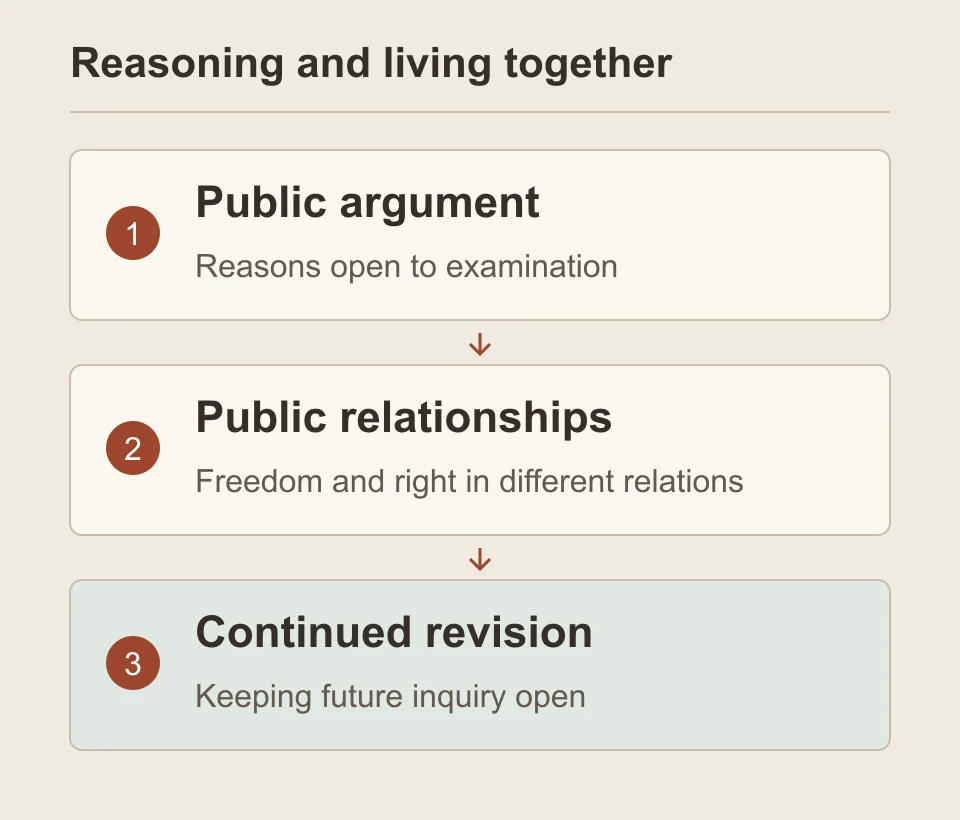
An original diagram connecting public argument, relationships, and revision. It is not a summary of contemporary law.
Compare three proposals through grounds and principles
A fictional local-history museum plans an exhibition using residents' interviews after attendance declines. Its materials mix securely dated records with anecdotes of uncertain provenance. Some residents agreed to educational display but do not want paid advertising uses. The team wants a quick decision because of its opening date and budget. Good purposes, incomplete knowledge, and different choices meet in one case.
The first proposal would present uncertain anecdotes as fact and broaden the footage's uses if doing so attracts visitors. It emphasizes survival and education. The second says that the team means well and should be trusted to proceed. The third would identify the status of evidence, explain changed uses to participants, and create a defensible exhibition even on a smaller scale. The proposals cannot be assessed by their stated goals alone.
The first issue is the claim to knowledge. Presenting verified dates and tentative interpretations identically may lead visitors to accept them as equally established. Applying epistemology does not mean labeling every record a thing in itself and abandoning inquiry. It means explaining evidence and added inference. Language about philosophical limits cannot excuse gaps that empirical investigation could address.
The first proposal also contains a maxim. Working for education does not specify the action to be assessed. A more accurate principle is presenting unverified stories as facts to improve the exhibition's success. Its effectiveness depends on visitors trusting the display as evidence-based. Universalization can ask whether the team relies on that trust while exempting itself from the conditions supporting it.
This examination differs from predicting reputational damage if the practice is discovered. The principle remains questionable even if discovery is unlikely and attendance rises. If educational institutions may conceal evidential status for their own purposes, how can the relation that makes their accounts credible be sustained? The problem is the particular point at which the maxim weakens a condition on which it relies.
The second proposal risks substituting benevolent feelings for good will. The team's commitment to education matters, but does not remove the need to check available material and provide necessary explanations. The jewel analogy distinguished misfortune despite serious effort from failure to use available means. Declaring that one's heart is in the right place cannot replace the work of implementation.
The humanity formula brings another issue into view in the footage. What information did residents receive and to what purpose did they agree? Treating the first permission as automatically covering another use may exclude their judgment from the plan. The organizers must consider the person's choice as well as the useful footage they supplied. A forecast that income benefits the community cannot occupy that person's place.
Autonomy asks whether the organizers are bound by the principles they make. If their own interviews cannot be used in unwanted advertisements while residents' footage can be used in the name of public benefit, a personal exception appears. The kingdom of ends evaluates this through equal legislation. Neither managerial power nor majority approval guarantees justification.
Public explanation requires reasons anyone can examine. Relying on an institutional title or Kant's name could merely substitute another authority for judgment. The evidence checked, the principle adopted, and what it required giving up offer something others can examine. Criticism then calls for attention to its grounds rather than merely the critic's manner. Public reason appears in assessable explanations, not in looking victorious.
The third proposal is not necessarily easy or costless. A smaller exhibition may attract fewer visitors, and further checks take time. Distinguishing possible success from justification means that cost alone does not settle the principle. Conversely, invoking a principle does not excuse ignoring costs or harms. Practical judgment about available means remains necessary.
The way apparently conflicting demands are framed can hide alternatives. Framing the choice as honesty versus survival may hide possibilities such as removing an unverified anecdote and reorganizing other material. No easy alternative is guaranteed, but the first proposed route may not be the only one. Principles do not replace imagination or inquiry; they help identify the standards by which alternatives should be sought.
The final judgment includes revisability. New evidence may change the historical account, and fresh agreement may change the footage's uses. Neither necessarily amounts to abandoning respect whenever convenient. Distinguishing facts, interpretations, and maintained moral principles can make revision a more accurate application rather than a loss of consistency.
Three relationships shaping the museum's choices
Claims and grounds
The standing of records and memories affects what the exhibition can present as fact.
Purposes and people
A shared educational purpose does not decide every form of participation or footage use on residents' behalf.
Explanation and revision
New evidence changes the display without canceling a resident's refusal.
Connecting these questions leaves judgments about schedules, costs, and implementation unresolved. This is an editorial map of the case, not an exhibition procedure supplied by Kant.
Kant's name cannot stand in for an argument
Attaching a source's name does not prove a conclusion. Which formulation and which facts support an inference matter more than an imagined announcement that Kant would disapprove. The choices and conversations below were composed by the editors. They neither reproduce Kant's voice nor suggest that he personally drafted a contemporary institution's rules.
Giving every theory equal space in one case can let irrelevant concepts obscure the explanation. Reliability, deception, and residents' purposes are central here, while scheduling and costs require separate investigation. Problems clarified by Kant's distinctions coexist with factual and institutional matters those distinctions cannot resolve. An adequate judgment depends on precise connections rather than an impressive list of terms.
Fictional case: decisions that outlast opening day
At the final meeting before opening, planner Seojin proposes a smaller exhibition. Rather than present the central anecdote as established fact, the display would distinguish verified records from a resident's memory. The production manager points to a large panel already printed: replacing it would consume the lighting budget for another room. Seojin does not pretend that the cost is trivial. But money already spent cannot change the story's evidential status. If an account is compelling only because visitors take it as historical fact, the way their belief is obtained is already part of the problem.
Interview participant Miyeong permits the exhibition to use her footage but declines its use in advertising. The team explains that attracting visitors could help preserve local records, a purpose she shares. Miyeong still does not want her face to represent the promotional campaign. Sharing an end does not mean agreeing to every means. The team removes her segment from the advertisement and explains changed uses to other participants. Asking again does not make every possible use justified, but leaving room for refusal has at least changed the original plan.
The smaller exhibition opens. Some visitors who booked in advance are disappointed by the difference from its publicity; one colleague thinks postponement would have been better. Seojin explains why opening with verified material seemed feasible, but questions remain about how carefully the team compared rescheduling costs and visitors' expectations. Invoking a principle does not invalidate that criticism. The team publicly identifies material omitted and uses abandoned without publishing residents' personal reasons for refusal. Explaining responsibility and exposing the people involved all over again are different actions.
A month later, a newly discovered record confirms part of the omitted anecdote. Seojin updates the display while continuing to respect Miyeong's refusal of advertising use. Evidence changing a historical claim does not thereby authorize every use of footage. The exhibition remains smaller than planned, losses remain, and disagreement about postponement has not disappeared. Yet the reasons for changing one decision while maintaining another are visible. The distinctions between knowledge and morality developed across this series illuminate that difference. Responsibility for a judgment lies less in stubbornly defending an answer once chosen than in continuing to explain its grounds as facts change and other people's purposes remain in view.
Facts, concepts, and application
- 01
Revising facts and changing principles: responding to new evidence differs from abandoning a principle for convenience. The issue is which decisions a changed fact actually affects.
- 02
Source claim and contemporary conclusion: a concept may assist judgment without every detail of the application appearing in the original work. The interpreter remains responsible for explaining the connection.
- 03
Argument and authority: naming an author differs from explaining the route from grounds to conclusion. A greater number of citations cannot fill a gap in the reasoning.
Where to check the argument
This is an English localization of our original Korean lesson. Source arguments, editorial interpretation, and fictional applications are distinguished; no dialogue is presented as Kant speaking to a contemporary reader.
Read the sections and editions identified below alongside the explanation. AA refers to the Academy edition's volume and page; A/B identifies the two editions of the Critique of Pure Reason.
- Critique of Pure Reason, second-edition preface and phenomena/noumena: empirical judgment and cognitive limits; historical English translation by Meiklejohn. ↗
- Groundwork of the Metaphysics of Morals, Sections I–III: good will, universal law, humanity, and autonomy; historical English translation by Abbott. ↗
- An Answer to the Question: What Is Enlightenment? (1784): reasons offered for public examination; German transcription with English explanation in this lesson. ↗