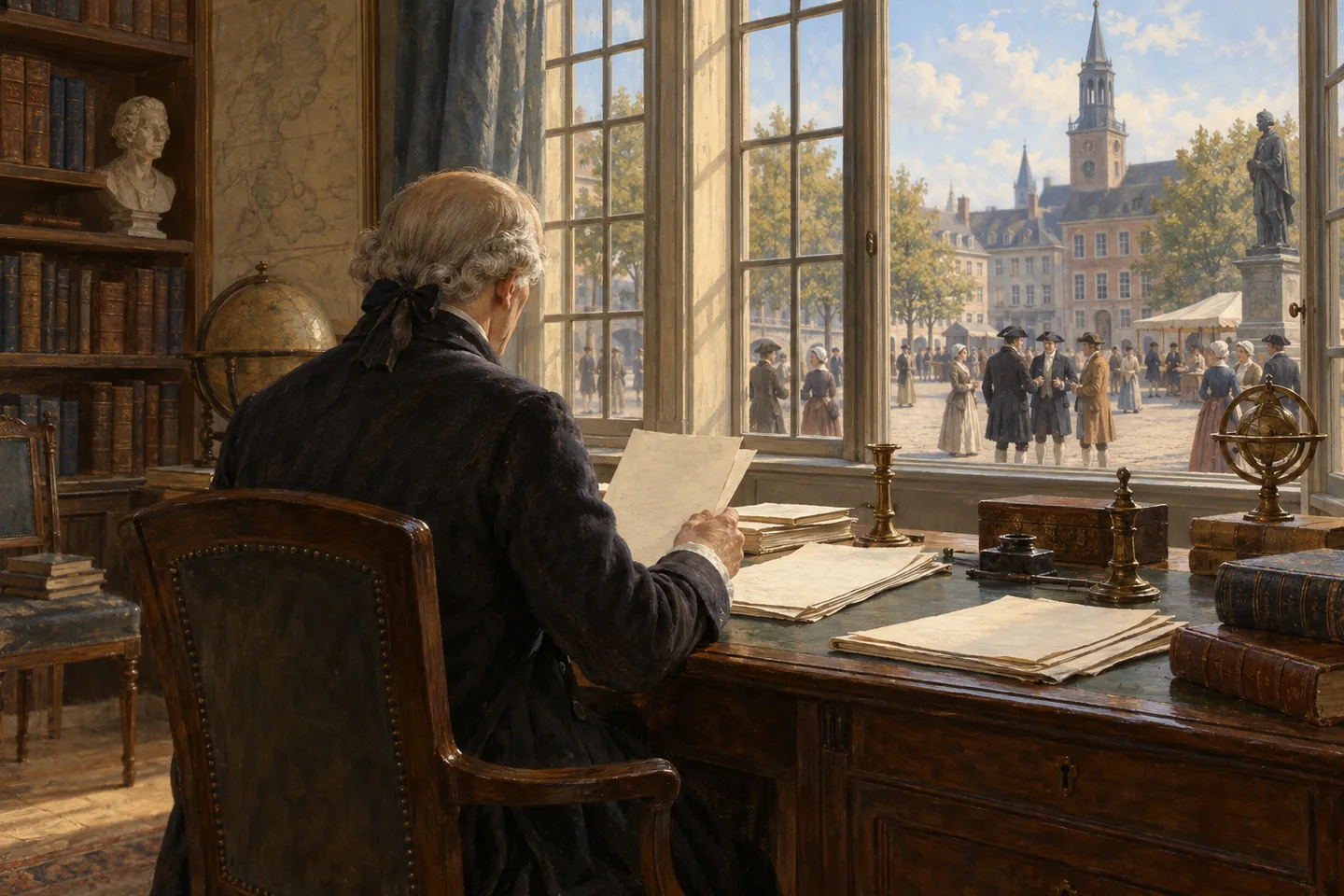
The question of 1784 and an unfamiliar distinction
This short essay responds to a discussion in the Berlin Monthly. Kant writes under the conditions of monarchy, religious authority, official duties, and publication in 1784. We need neither read it as a completed modern constitution of civil liberties nor dismiss its questions as obsolete. Distinguish what the text means from the additional judgments contemporary applications require.
The immaturity of the opening passage is not simply youth or a shortage of information. It is an inability to use one's understanding without another's guidance. Kant calls it self-incurred when its cause lies in a lack of resolution and courage rather than understanding. Omitting that qualification risks blaming everyone denied education or subjected to oppression for laziness.
The course's editorial explanation is checked against a transcription of the 1784 German text, AA 8:35–42. Public and private have especially important technical meanings here. Do not convert them directly into everyday advice to hide personal thoughts and obey public institutions. Understanding the vocabulary makes both the essay's possibilities and its tensions visible.
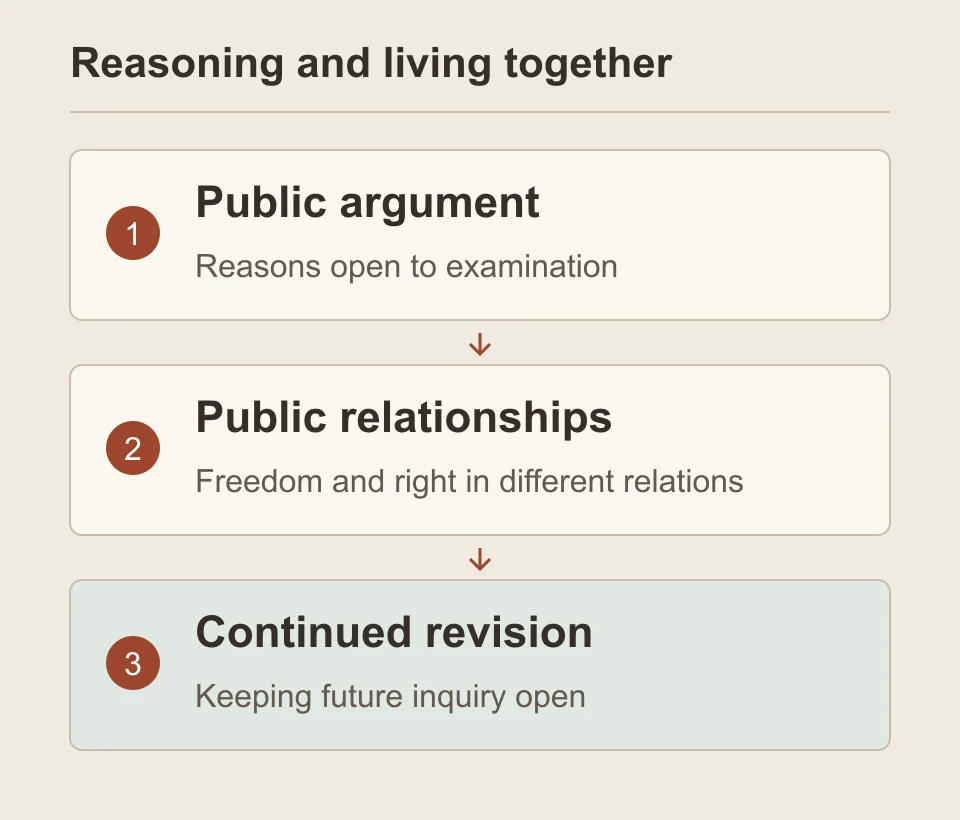
An original diagram connecting public argument, relationships, and revision. It is not a summary of contemporary law.
From guardianship to publicly giving reasons
Kant begins with a book that thinks for me, a religious adviser who manages my conscience, and an expert who decides aspects of my life. Reading or seeking advice is not itself the problem. It is surrendering the use of reason entirely, as though accepting a judgment required no examination of its grounds. The opening exposes the attraction of paying someone to remove the effort of thinking.
A guardian can stabilize dependence in the language of protection. Kant depicts people first prevented from walking alone and then warned how dangerous independent movement would be. This concerns more than individual cowardice: opportunities to exercise courage are restricted. Reducing the essay to self-improvement loses this social dimension. Practice and freedom to examine guidance are both necessary.
Thinking for oneself should not be read as becoming an expert in every field. We learn through others' investigations and explanations. The question is whether we can ask for grounds and correct mistakes. When an authority cannot be questioned and need not explain itself, the learner has surrendered not only a judgment but also the possibility of reviewing it. Respect for expertise differs from granting infallibility.
Kant recognizes the difficulty an individual faces in escaping an established habit, yet sees greater prospects for a public allowed freedom. Reading and testing one another's arguments can alter fixed judgments. Enlightenment is not simply a genius delivering the truth. Replacing a defective authority with a new one while preserving the same dependence has not yet changed the way people think.
The public use of reason is reasoning as a scholar before the reading public at large. Scholar should not be narrowly reduced to possession of a credential or professorship. What matters is offering reasons in one's own name for general examination, beyond merely transmitting instructions within a particular office. Whether the speaker stands in a square or sits at home does not determine the public character of the argument.
Private use, by contrast, concerns reasoning within an entrusted civil role or office. This is counterintuitive because ordinary contemporary language often calls workplaces and government institutions public. In Kant's distinction, use restricted to an institution's task is private. A person can address a large audience while acting as a representative transmitting an institution's teaching. Audience size is not the criterion.
The essay uses soldiers, taxpayers, and clergy as examples. It distinguishes requirements while performing a role from the freedom to publish criticism of the institution. Kant seeks conditions under which operation and criticism can coexist. His broad allowance for obedience nevertheless creates a tension. A contemporary reader cannot decide every response to an unjust order from these passages alone.
The clerical example also raises conscience. Kant distinguishes communicating a church's teaching from publicly presenting personally examined views, but says that someone unable to perform the office conscientiously must leave it. It is inaccurate to read the essay as leaving no place for individual judgment. Equally, it does not solve every contemporary question about refusal of duties or whistleblowing.
The argument expands to future generations. Can one generation make religious principles permanently unalterable and prevent later examination? Kant denies that authority. However solemn a current agreement, it cannot legitimately bind away the future possibility of correcting error and extending understanding. Freedom of thought concerns those who come after us as well as present individuals.
The difference between an enlightened age and an age of enlightenment also matters. A completed state of independent judgment differs from a process of establishing conditions for it. Announcing that authority has diminished does not instantly change abilities and habits. People long accustomed to delegating thought need time to read, question, and revise. Freedom and education must be considered together.
Read the essay's universal language alongside its historical limits. It contains a prejudiced reference to women and imagines freedom within an enlightened monarch's order. Rewriting it as if equal participation were already realized would confuse source and commentary. Acknowledging these limits still allows us to ask whose judgment is being replaced and whose questions are being blocked.
Even the slogan of thinking for oneself can become another guardian's formula if accepted without examination. Independence lies less in feeling unshakable than in making visible the grounds of a judgment and what could change it. Public reasons leave room for someone else to identify an error. Enlightenment points toward a relationship in which people can correct mistakes together without waiting solely for authority's permission, rather than a state in which every judgment is already right.
Relations that make enlightenment possible
Delegated judgment
Identify who decides for whom and which questions are blocked.
Public argument
Offer reasons open to general examination beyond a particular assigned role.
Continued revision
Keep present agreement from closing future inquiry.
Historical demands of obedience and contemporary institutional conditions are not treated as identical.
Independence is not isolation from evidence
Public reason is not an instruction to disclose all information indiscriminately. Contemporary privacy, professional information, and others' rights require particular judgment. Freedom of public argument and the legitimate scope of disclosed material must be considered together. The historical text does not authorize exposing other people's information at will.
Thinking for oneself does not remove the need to hear reliable expertise or others' experience. Independence connects with learning and assessing evidence. Someone who dismisses every disagreement as authoritarian may invoke enlightenment while closing off the examination it requires.
Fictional case: a guide revisits a museum label
In this fictional case, museum guide Narae has long described a group's arrival as a change welcomed by the whole town. One day a visitor says that her grandmother left because nobody would rent her a home. One memory cannot establish that the entire exhibition is false, but the word everyone is also unsupported. The archive contains both a welcome ceremony and letters complaining of refusals to rent. A sentence Narae once recited easily has become a claim she can no longer repeat without difficulty.
Her supervisor replies that the label passed several reviews and that immediate changes would leave guides giving inconsistent accounts. Coordinating their work matters, but previous approval does not make conflicting evidence disappear. Narae requests a correction while preparing an article about the settlement using publicly available sources. Delivering an institution's assigned account and presenting reasons to the reading public in her own name are different roles. Even if she writes at home, the latter resembles public use of reason in Kant's sense. The distinction concerns the role of her argument, not the room in which she writes.
Narae's first draft declares that the museum concealed an uncomfortable history. A colleague points out that they have not established who omitted the evidence or why. She revises the claim: what they can show is a mismatch between the display and the records. Being subject to criticism herself makes her hesitate, but also clarifies her grounds. She does not publish the visitor's family story without permission. Freedom to argue publicly does not itself authorize using another person's information, and Kant's distinction alone does not determine present workplace rights and obligations.
The museum removes everyone but postpones a larger revision until its budget review. Responses to Narae's article include further memories and complaints that she has encouraged distrust. One correction neither restores trust nor ends the dispute. Yet there are now sources to examine and claims to challenge. Continuing what one person's courage began requires relationships in which criticism can be considered and explanations revised. The next lesson changes the scale to relations between states, asking what can sustain a peace that goodwill alone cannot secure.
Facts, concepts, and application
- 01
Thinking for oneself and knowing alone: learning everything independently differs from examining others' explanations through reasons. Learning and independent judgment can coexist.
- 02
Public and private use versus location: audience and role matter more than home versus square or small versus large audience.
- 03
Present agreement and future examination: an arrangement for operating today's institutions does not confer a right to eliminate future generations' freedom to think.
Where to check the argument
This is an English localization of our original Korean lesson. Source arguments, editorial interpretation, and fictional applications are distinguished; no dialogue is presented as Kant speaking to a contemporary reader.
Read the sections and editions identified below alongside the explanation. AA refers to the Academy edition's volume and page; A/B identifies the two editions of the Critique of Pure Reason.
Independent reference: Stanford Encyclopedia of Philosophy: Immanuel Kant ↗