
Rational beings as ends in themselves
At AA 4:428–430 in Section II of the Groundwork, Kant asks what can be an end in itself. An object valued because I want it differs from a being whose worth should not depend on another person's desire. Kant presents rational nature as an end in itself and expresses this in the humanity formula. Before identifying it with a modern list of human rights, examine its role in the original argument.
The previous lesson asked whether a maxim could be conceived and willed as a universal law. This formulation brings the status of rational beings within an action to the foreground. Kant presents the formulas as connected expressions of the same moral law. They are not independent rulebooks from which we can select whichever grants an exemption.
The interview example below is a contemporary invention, not a case from Kant. Investigating information and the possibility of refusal is an application intended to clarify the humanity formula. It does not specify current legal requirements for consent, privacy, or contracts. The philosophical principle and the rules of particular institutions are connected but require distinct examination.
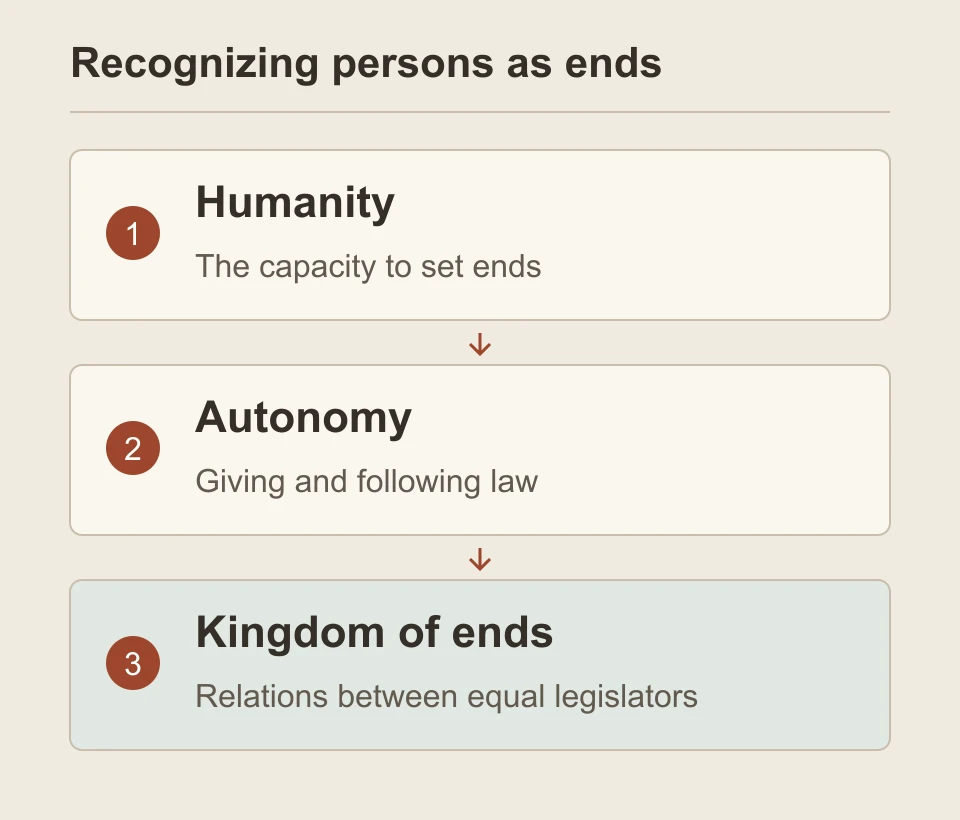
An original diagram linking humanity, autonomy, and the kingdom of ends. It depicts neither an actual state nor two separate worlds.
Deception, consent, assistance, and humanity
Kant distinguishes ends we choose from an end in itself that can constrain every chosen end. The value of a desired object may change with desire. If a rational being's value were determined only by usefulness to someone, an unhelpful person could simply be discarded. The humanity formula challenges making this conditional evaluation the final standard of action.
Humanity here differs from kindness or a warm feeling toward humankind. Kant concerns himself with the character of a being capable of setting ends and judging rationally. Another person is not merely a component in my planned outcome but an agent who can determine action for reasons. This status must figure in respectful conduct. Asking only whether I feel warmly toward them misses the issue.
Consider the scope of means. I learn through a teacher's explanations and have an object repaired through a technician's skill. They may earn a living or pursue other purposes through that cooperation. A means-end relationship within collaboration is not automatically prohibited. The question is whether using someone's contribution also recognizes their judgment and purposes.
Deceptive promising becomes more concrete from this perspective. The lender believes the borrower intends repayment. Since the actual plan is concealed, the lender has no opportunity to agree to that plan as it really is. The promiser withholds a fact essential to judgment and directs the other's choice toward the promiser's end. An outward agreement alone does not establish that the person was treated as an end.
Deception can be more than an accidental delivery of incorrect information; it can be a way of manipulating choice. Someone concealing an actual intention cannot straightforwardly claim to respect the other's judgment. Instead of allowing an informed choice, the agent incorporates the other's ignorance into the plan. The humanity formula reveals the same difficulty as the universal-law example from another angle.
Coercion also limits the place of another person's judgment. Yet not every constraint or obligation is automatically wrongful coercion. Undertakings and rules can establish conditions under which freedoms are recognized together. Ask what justifies a restriction and whether the other person is treated as a participant to whom reasons are owed. Being unable to do exactly what one wants does not alone settle whether respect is present.
Actual consent matters, but is not automatically sufficient. What information was available, what pressures distorted the choice, and what was agreed to? More fundamentally, Kant's principle also applies to one's own humanity, so willingness to dispose of oneself in any way does not immediately justify everything. Treating a signature as the end of moral inquiry narrows the principle too far.
Treating others as ends raises questions beyond refraining from harm. Kant also discusses making others' ends, so far as possible, one's own. Complete indifference differs from a relation in which we help pursue another's legitimate purposes. This is not an unlimited demand to satisfy every desire. Judgment is required about what to support and why, and the helping agent also has the status of an end.
Respect differs from benevolently deciding in someone else's place. A person may supply what they consider a beneficial result while refusing to hear the recipient's explanation. The humanity formula makes the recipient's own purposes visible. Insisting on unwanted help or demanding gratitude can combine material benefit with a denial of agency. This reconnects with lesson four's examination of good will.
Do not turn this principle into an ability test. Difficulty making an argument or needing substantial assistance does not establish a lesser claim to respect. Further work is required to connect Kant's account of rational nature with contemporary questions of disability, care, and equality. This course does not rank dignity by test scores or productivity. Studying a historical argument differs from using it to justify exclusion.
The practical question is clear: have I included what this person knows, wants, and chooses in my judgment? Or have I counted them only as something I can move toward my desired result? Answering requires investigating the relationship. Repeating the word respect is insufficient; the principle must appear in the design of the task, its explanation, and the conditions of choice.
The same formula applies to one's own humanity. My judgment and purposes also matter beyond instrumental achievement. Thinking that I have value only when I satisfy every expectation measures me solely by usefulness to others. A relationship recognizing people as ends includes oneself.
Where does the other person stand in cooperation?
My purpose
State what I want this cooperation to achieve.
Their judgment
Identify what they know and the purposes for which they choose.
A relation both can recognize
Examine whether my success depends on excluding their judgment.
This asks about a person's status, rather than offering a technique for obtaining agreement.
Respect is neither liking nor unlimited approval
Treating someone as an end does not mean doing everything they want. Considering legitimate purposes differs from approving every demand. Refusal can still explain reasons and recognize the other person's judgment. Equal respect is not agreement with every choice.
Do not hide Kant's historical prejudices behind the humanity formula. His writings contain discriminatory judgments about sex and race. This lesson examines what the principle requires and permits asking whether he applied it consistently. Advocating universality does not mean that every statement the author made realized universal respect.
Fictional case: changing the use of an interview
This neighborhood exhibition is an editorial invention. Planner Dain has filmed Miyeong recalling an old shop. She participated to preserve the work of neighbors whose businesses have disappeared. A sponsor later offers funding if the footage can also appear in merchandise advertising. Seeing Miyeong smile in the recording, Dain assumes she would be pleased. Yet looking comfortable during filming does not establish that she has chosen this new purpose for the material.
Miyeong continues to support the archive but does not want her face to recommend a product. Dain starts suggesting removal of her name or a shorter clip, then realizes he is treating her answer as an obstacle to modify. Such alternatives could help if the issue were simply the extent of exposure. They cannot erase the purpose she has actually explained. The organizer's calculation of benefits to the exhibition was taking the place in which the participant's judgment should remain.
Dain proposes different advertising to the sponsor. Funding falls and some planned facilities are dropped. A colleague asks whether other visitors are paying the price of respecting one resident. Dain remains responsible for investigating those losses and finding alternatives. But making Miyeong feel guilty for withholding agreement would repeat the original problem. The humanity formula does not supply a correct exhibition budget. It reveals whose judgment is excluded in the pursuit of a desired result.
After opening, Miyeong sees her contribution without approving every decision about the exhibition. Dain does not demand gratitude or future participation because he respected her refusal. Cooperation uses one another's abilities while leaving room for distinct purposes. This one episode does not certify that every condition of consent and respect has been satisfied. It does reveal a difference between deciding another person's good for them and preserving their place in the choice. The next lesson considers such agents as makers and followers of common principles through autonomy and the kingdom of ends.
Facts, concepts, and application
- 01
Means and mere means: using abilities in cooperation differs from using a person while excluding their judgment and purposes. The formula does not prohibit asking for assistance.
- 02
Agreement and conditions of choice: a signature differs from informed agreement to a particular plan. Examine the roles of deception and pressure.
- 03
Respect and liking: one can recognize another as an agent without warm feelings. Conversely, affection does not justify deciding everything for them.
Where to check the argument
This is an English localization of our original Korean lesson. Source arguments, editorial interpretation, and fictional applications are distinguished; no dialogue is presented as Kant speaking to a contemporary reader.
Read the sections and editions identified below alongside the explanation. AA refers to the Academy edition's volume and page; A/B identifies the two editions of the Critique of Pure Reason.
- Groundwork of the Metaphysics of Morals, Section II, AA 4:428–430: humanity, deceptive promising, and assistance. Checked against T. K. Abbott's historical English translation. ↗
- Stanford Encyclopedia of Philosophy, Kant's Moral Philosophy: humanity, dignity, and discriminatory views in Kant's work. ↗