
What principle does the Groundwork seek?
Published in 1785, the Groundwork seeks to identify and justify the supreme principle of morality. It is not a catalog of every social rule. Section I begins with ordinary moral judgment and tries to make its underlying principle philosophically explicit. This is why the question of why someone acts keeps returning.
The passages for this lesson are AA 4:393–405. AA identifies volume and page numbers in the Academy edition of Kant's works, not the variable pagination of a particular translation. This original editorial explanation has been checked against Thomas Kingsmill Abbott's historical English translation. The contemporary examples below are invented to illuminate an argument; they are not records of Kant's actions or statements.
Having asked about the grounds of claims in epistemology, we now ask about reasons for action. Our inability to see another person's motives completely does not eliminate distinctions between moral reasons. It does, however, caution against using those distinctions to issue easy verdicts on someone's character. Begin by explaining which reasons you yourself adopt as principles of action.
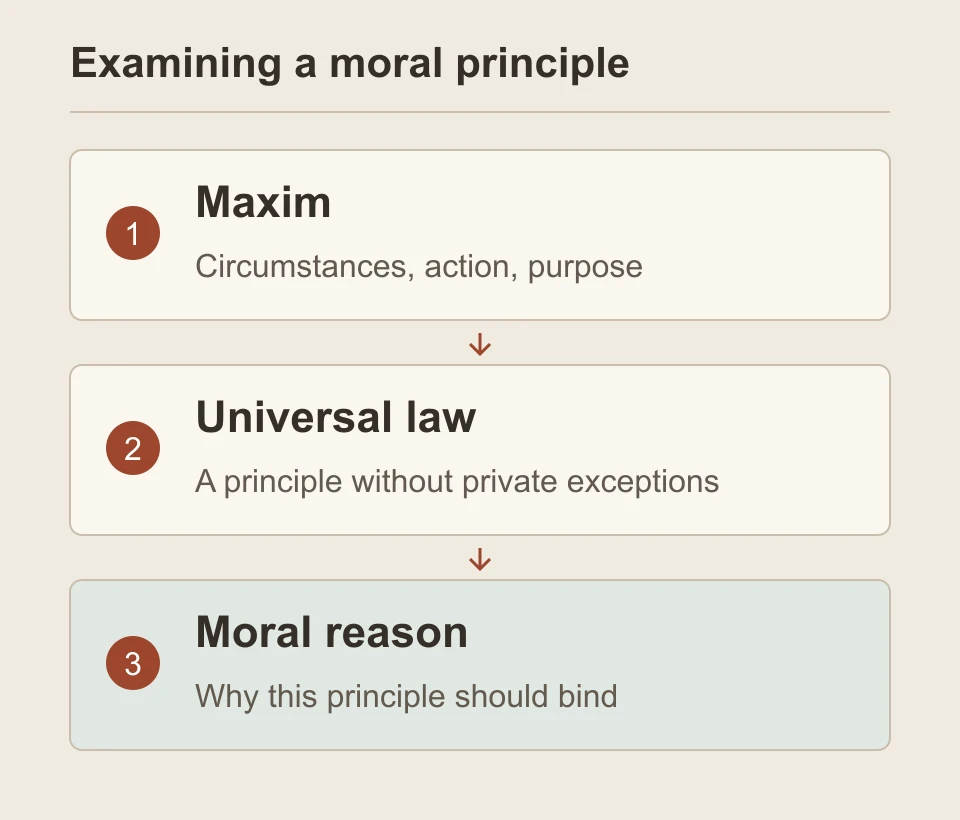
An original conceptual diagram. It does not calculate moral worth from outcomes alone.
Good will through the jewel, dealer, and helping cases
The opening claim is strong: only a good will can be called good without qualification. Kant does not say that intelligence, courage, or perseverance are worthless. Such abilities can nevertheless increase harm when put to cruel purposes. Calm judgment can make wrongdoing more effective. We must distinguish the strength of an ability from the goodness of the will employing it.
Happiness receives a similar examination. Wealth, honor, health, and satisfaction can be desirable, but do not guarantee moral worth independently of how their possessor acts. This is not an ascetic command that pursuing happiness is bad. It asks whether happiness can provide the final justification for any action. My satisfaction alone cannot make my treatment of someone else right.
The jewel analogy explains why a good will does not obtain its value from achievement. If someone makes sufficient effort but misfortune prevents success, the good will does not lose its worth. Kant explicitly distinguishes willing through the use of available means from merely wishing. A person who neglects preparation and then appeals to kind intentions leaves out an essential condition of the argument.
Why introduce duty? Human beings do not automatically follow every principle reason presents. Desire, fear, and convenience can conflict with it, so a requirement appears as something we ought to do. To clarify good willing under human conditions, we examine the reason for acting amid such conflict. Duty does not simply mean obeying an external authority's instruction.
Consider the honest dealer. Inexperienced customers are charged the same price as others and are treated fairly: the conduct conforms to duty. In Kant's example, however, the dealer acts for lasting trust and personal advantage. The outward action alone does not show that it was done from duty. The question remains whether the same principle would be decisive when honesty becomes costly.
This distinction does not make every profitable honest action bad. It separates conformity with duty from the motive in which moral worth is located. Kant should not be reduced to a formula in which morality vanishes whenever desired outcomes and duty coincide. His example establishes that conduct motivated solely by advantage cannot be explained as respect for duty itself.
The example of helping brings sympathy into the discussion. A disposition to enjoy another's happiness can be attractive. Kant asks whether a reason to help remains on a day when that feeling is absent. Another person's need does not become important or unimportant merely as our mood changes. Reading the passage as an instruction to extinguish every kind feeling misses its concern with the independence of moral reasons.
The person who helps despite grief and an absence of sympathetic feeling is a contrast intended to reveal that independence. It does not establish that more suffering automatically produces greater moral worth. There is no need to make oneself emotionally cold or make assistance harder. The question is why one acted, rather than how much one suffered. Duty is not dependent on a favorable mood.
Respect also differs from ordinary admiration. It is not attraction to a rich person's prestige or a hero's charm as an external reward. It concerns awareness that a law constrains arbitrary choice. The agent recognizes a rational principle as binding without claiming an exception. Respect for moral law must therefore be distinguished from unconditional obedience to a particular person.
Emphasizing action from duty does not grant perfect access to motives. Kant recognizes that self-love can disguise itself as a noble reason. It may be hard to establish whether pride was actually decisive. A conceptual distinction in moral philosophy is not a psychological report identifying every hidden motive. It gives us reason to examine our principles more honestly, rather than instantly dismiss another person's help as hypocrisy.
Section I moves toward asking whether a principle of action can hold for everyone. Choosing a personal exception for advantage differs from respecting a law valid for all. The next two lessons articulate this issue through maxims, imperatives, and universalization. Good will is not a flattering character label that ends the explanation. It names a problem with which the explanation begins.
Asking about principles before outcomes does not make experience useless. The Groundwork's preface recognizes that applying principles to particular cases requires judgment sharpened by experience. What another person needs and how a promise can be fulfilled depend on actual circumstances. Denying that calculations of happiness ground moral obligation is different from denying that action requires investigating facts.
Three levels in assessing an action
What was done?
Consider whether the conduct conformed to duty.
Why was it chosen?
Ask which reason became the principle of action.
How was it pursued?
Check whether the agent used available means instead of merely wishing.
This is a map for explaining reasons, not a test that reveals every hidden motive.
Good intentions do not end accountability
Do not treat good will as merely another expression for good intentions. Kant includes the use of available means. If someone neglected a foreseeable risk or omitted necessary preparation, an appeal to benevolence does not settle the matter. Saying that success is not the whole of moral worth differs from saying that the consequences of action need never be considered.
Do not create additional suffering in the name of duty. The presence of a helpful feeling need not automatically erase moral worth. Measuring Kantian morality by how much pain one tolerates or how successfully one suppresses a friendly expression misses the central question about the reason for choosing an action.
Fictional case: different reasons for the same delivery
In this editorially invented volunteer group, Soyeon and Jaemin deliver equal quantities of groceries. Soyeon hopes photographs will help a job application; Jaemin is troubled by family problems but comes because people are waiting. Soyeon smiles while Jaemin says little. Either appearance could tempt someone to judge sincerity. Yet enjoying assistance differs from assisting only for that enjoyment. Coming despite distress does not automatically confer greater moral worth either. The visible action leaves the reason for choosing it open to further consideration.
When photography is canceled the following week, Soyeon is disappointed but still takes her route because households already expect the delivery. This challenges the initial account that reputation was her only reason, without proving complete purity of motive. Jaemin likewise acknowledges both valuing his undertaking and wanting to appear dependable to the group. Kant's distinction does not rank the two volunteers. It reveals the question of what becomes decisive when several reasons accompany the same choice.
On delivery day, heavy rain closes part of the route. The group checks alternatives and communicates delays, but some supplies still arrive late. A recipient complains that another appointment was postponed while waiting. Sincere effort does not erase that inconvenience. Meanwhile, a team that saw the warning but neglected to confirm contact details cannot explain everything through misfortune. The jewel analogy concerns both the will to use available means and failure that can remain despite that effort, rather than only whether the final result was bad.
The group investigates the effects of delay and improves its contact arrangements. Finding out what recipients need differs from measuring moral worth solely by results. Soyeon may still enjoy recognition while the question remains whether her undertaking depends entirely on that reward. Jaemin's somber expression cannot supply the answer either. The next lesson clarifies this difference through maxims. Even outwardly identical actions may embody different principles according to their circumstances and the reasons for choosing them.
Facts, concepts, and application
- 01
Conforming to duty and acting from duty: outwardly identical actions can have different reasons. Use this distinction to ask about moral worth without claiming complete knowledge of another person's inner life.
- 02
Wishing well and willing well: hoping for a good result differs from using available means to act rightly. Uncertain success does not eliminate the need for effort.
- 03
Feeling and principle: having a desire to help differs from having no reason to help except that desire. Explain what reason remains when the feeling changes.
Where to check the argument
This is an English localization of our original Korean lesson. Source arguments, editorial interpretation, and fictional applications are distinguished; no dialogue is presented as Kant speaking to a contemporary reader.
Read the sections and editions identified below alongside the explanation. AA refers to the Academy edition's volume and page; A/B identifies the two editions of the Critique of Pure Reason.
Independent reference: Stanford Encyclopedia of Philosophy: Immanuel Kant ↗