
Universalization assesses a maxim of action
At AA 4:421–424 in Section II of the Groundwork, Kant introduces the formula and examines four examples. They distinguish duties to oneself from duties to others, and strict duties from duties requiring a wider practice. We focus on deceptive promising and the refusal to help so that their argumentative differences remain clear.
The maxim developed in the previous lesson becomes the object of assessment. Naming the action borrowing money is insufficient. Kant's example involves escaping difficulty by promising repayment without intending to repay. Omitting the intention and the promise would produce the mistaken conclusion that borrowing as such is morally forbidden.
Our contemporary example concerns booking an art studio. It does not replace legal judgment about lending or contracts. It asks whether an agent achieves a purpose by relying on a practice while undermining the conditions that make it possible. Harm to another person and contradiction in a universalized maxim are related concerns, but they are not the same argument.
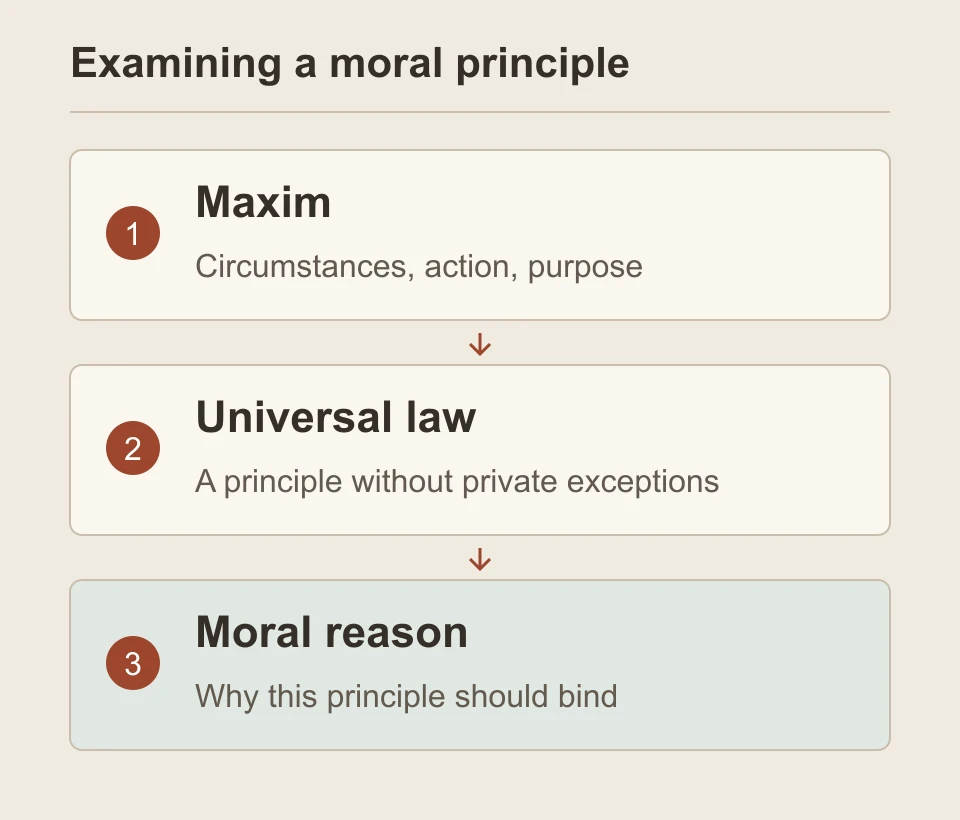
An original conceptual diagram. It does not calculate moral worth from outcomes alone.
Why deceptive promising and refusing help differ
The universal-law formula requires acting on a maxim that one can at the same time will as universal law. It rejects a structure in which I take an exception while others must follow the rule. But it is not simply a demand that everyone make the same movements. The conditions of action and the reason for choosing it belong to the content of the law.
The deceptive promiser needs another person to believe the promise. An assurance of repayment must be accepted as a credible undertaking for the borrowing to succeed. The agent relies on that practice while having no intention to repay. Because the purpose requires the practice of promising to function, universalizing the maxim raises a question about whether its basis can survive.
Under a law permitting anyone in difficulty to promise without intending repayment, the assurance could no longer generate the same trust. Kant's point is not merely a prediction that a few lies will make society unpleasant. The maxim defeats the possibility of the promising on which achieving its purpose depends. This is a contradiction arising in conceiving the universalized maxim.
Suppose the agent now assumes that discovery is impossible. Punishment and reputational damage may disappear from the calculation. The structure in which others must be reliable while I claim an exception has not disappeared. Kant's assessment therefore differs from technical advice permitting deception whenever its detection risk is sufficiently low. Validity and successful concealment are different questions.
Now consider refusing help. Someone doing well adopts a principle of never assisting others in difficulty. A world governed by that principle does not immediately collapse conceptually as the deceptive-promise practice does. A world where nobody helps is conceivable. Treating both examples as the same contradiction loses Kant's distinction.
Kant next asks whether such a world can be willed as universal law. A rational but finite agent may need others' cooperation to pursue purposes. Willing a law that excludes every possibility of assistance removes something the agent may also need. This distinguishes conceiving a principle from rationally willing it as a universal rule.
Do not reduce the argument to helping now in order to obtain repayment later. No particular person's guaranteed gratitude or forecast financial return grounds it. The issue concerns a finite agent's pursuit of ends and possible need for help in relation to a will that universally excludes assistance. Judgment is still needed about the timing and form of particular acts of help.
The distinction between perfect and imperfect duties becomes meaningful here. Refraining from deceptive promises and adopting others' benefit as an end have different practical forms. Imperfect does not mean less morally important or optional. It leaves latitude about whom to assist, when, and how. It does not immediately require satisfying every request at every moment.
Universalization is not an opinion poll. Widespread approval can coexist with a maxim undermining its own conditions. Unpopularity does not by itself constitute a contradiction either. Investigating actual agreement and examining whether a principle can be willed as a law valid for all are different tasks. The kingdom of ends introduced later is likewise not simply a name for majority voting.
Describing the maxim remains difficult. A test can be distorted by narrowing circumstances to fit a preferred conclusion or embellishing the purpose. An exception limited to my birthday at one particular hour does not supply a morally relevant distinction. Actual consent and the terms of an undertaking, however, cannot simply be erased. Honest description and concrete judgment belong together in universalization.
This is not a machine into which any sentence produces an automatic answer. The argument depends on whether the maxim captures the actual reason, what practice it relies on, and which kind of contradiction appears. Deceptive promising and refusal of assistance can both be problematic without sharing the same argumentative connection. Losing that difference reduces universalization to asking which outcome is more inconvenient.
Kant's instruction to consider a maxim as universally operative like a law of nature does not reduce morality to physics. It asks us to imagine a consistent order from which nobody can arbitrarily exempt themselves. The fact that many people actually violate a principle does not immediately disprove its validity. What happens and what ought to happen remain distinct.
The steps of universalization
State the maxim
The relationship between circumstances, action, and purpose reveals the actual reason for choosing.
Conceive it as law
Ask whether the practice it relies on can exist under universal application.
Will it as law
Where the practice is conceivable, ask whether a rational agent can will that principle.
This separates two kinds of contradiction rather than merely calculating how bad an outcome would be.
Avoid reducing the test to crowding or popularity
If everyone visits the same shop simultaneously, crowding alone does not make shopping there immoral. Physical capacity differs from contradiction in a moral principle. Examine what maxim is recognized for agents in the same relevant conditions, rather than merely imagining simultaneous copies of an action.
The persuasiveness of each of Kant's four examples can be assessed separately. This lesson reconstructs two intended distinctions through deceptive promises and refusing help. Understanding those distinctions does not mean that every possible duty has already been fully specified. Complex cases still require factual inquiry and interpretation of principles.
Fictional case: why a studio trusts a booking
In this editorially invented art studio, Yura firmly commits to using a space next month. Privately she plans to disappear without notice if a better venue appears, while wanting the organizer to decline other applicants and hold her place. After finding somewhere cheaper, she argues that a replacement applicant could prevent anyone losing out. Yet she gained time to choose precisely because her original assurance was accepted as a genuine undertaking. The success of the plan depended on that reliance.
The organizer points out that Yura used the undertaking while exempting herself from its binding force. If anyone in those circumstances could secure space through assurances they never intended to honor, such assurances could not guide decisions in the way her plan requires. The maxim conflicts with a condition on which it relies, independently of whether the vacancy is eventually filled. Actual losses still require attention, but their absence would not justify the initial deception.
Exhausted by the dispute, the organizer declares that participants in difficulty will never receive help again. A different structure now appears. A studio without mutual assistance remains conceivable; its means do not immediately collapse in the way deceptive assurance does. Kant asks whether finite agents who may need assistance can will that principle universally. This does not require readmitting Yura or resolving every participant's difficulties. Adopting others' benefit as an end differs from deciding whom to help, when, and how.
For future bookings, the studio makes cancellation periods explicit and considers feasible rescheduling when unexpected circumstances arise. Yura's preferred date has already gone to someone else, and new rules do not erase the earlier event. These arrangements are an editorially invented response, not operating rules supplied by Kant. What remains clear is that refraining from deceptive promising and fulfilling a duty of assistance have different practical forms. The next lesson considers the same deception as depriving another person of an opportunity to judge their own choice.
Facts, concepts, and application
- 01
Contradiction in conception and contradiction in willing: distinguish a universalized practice that defeats itself from one that can be conceived but not rationally willed. Do not collapse these tests into a single phrase.
- 02
Imperfect duty and optional action: latitude in implementation differs from absence of obligation. The end is to be adopted while its particular realization requires judgment.
- 03
Universalization and majority approval: the number of people favoring a rule differs from its validity. Popularity alone does not explain a contradiction.
Where to check the argument
This is an English localization of our original Korean lesson. Source arguments, editorial interpretation, and fictional applications are distinguished; no dialogue is presented as Kant speaking to a contemporary reader.
Read the sections and editions identified below alongside the explanation. AA refers to the Academy edition's volume and page; A/B identifies the two editions of the Critique of Pure Reason.
Independent reference: Stanford Encyclopedia of Philosophy: Immanuel Kant ↗