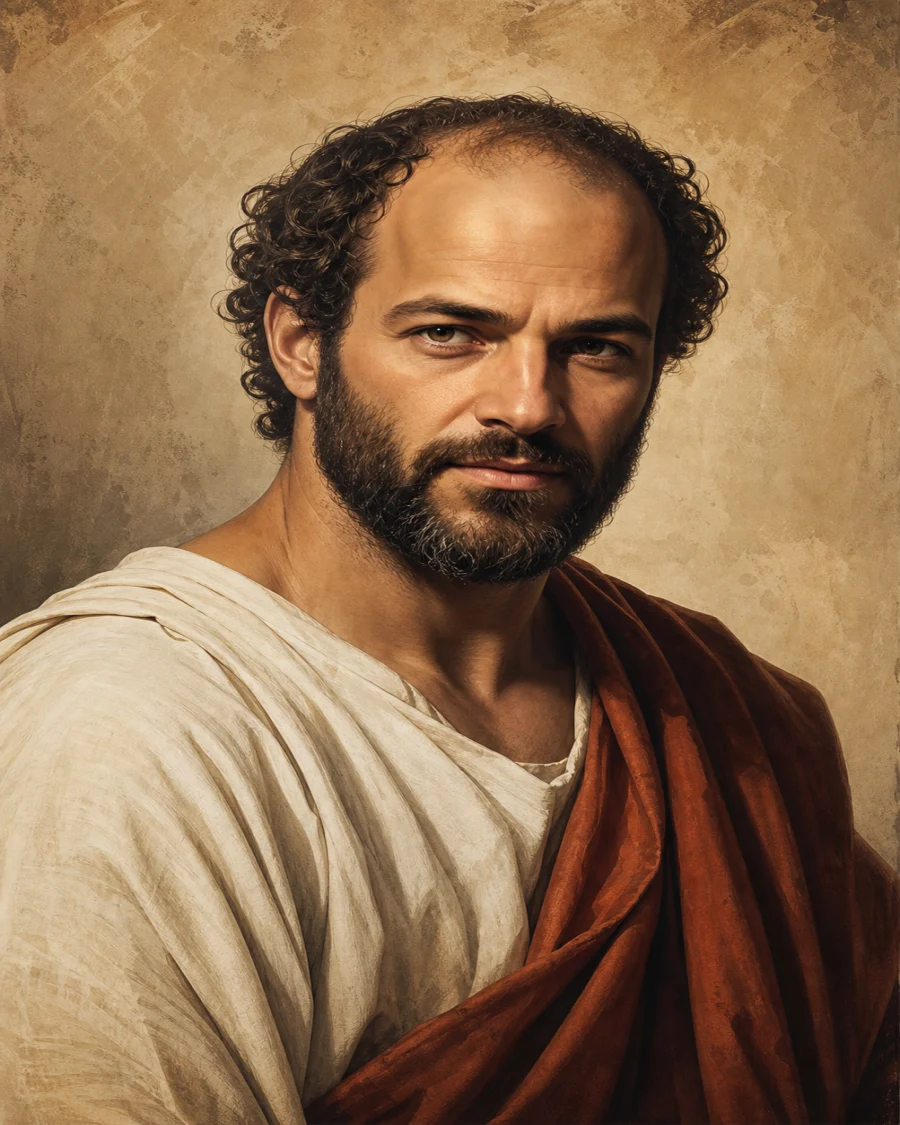
A city where speech carried power
In fifth-century Athens, speech was a form of civic power. Persuasion mattered in assemblies and courts, and education affected who could speak convincingly in public. Socrates belongs inside this environment. His questions about courage and justice challenged words that citizens already used to authorize decisions. Treating his method only as an abstract exercise in clear thinking loses the point at which a definition could unsettle someone's standing or claim to expertise.
Plato's Symposium recalls his endurance on military service. The account connects philosophical speech with conduct, but praise spoken by a character is not a neutral service record. Its value includes showing what admirers thought required explanation: did the person who questioned courage also face danger? Biography can retain that question while distinguishing a literary portrait from independently established detail. The relation between a claim and the life that supports it is part of the evidence itself.
Socrates was an Athenian citizen formed by a city confident in argument, competition, and public speech. Ancient sources place him in military service and describe an unusual endurance, but the familiar barefoot questioner is already a literary figure shaped by admirers and critics. He charged no formal tuition and founded no institution. His classroom was the city itself, where claims about courage, piety, justice, and expertise could be tested in front of the people who lived by them.
Refusing the order to arrest Leon
In Apology 32c–d, Socrates recalls the Thirty ordering him and four others to arrest Leon of Salamis for execution. According to the account, the others went to carry out the order, while he returned home. This is a particular refusal under danger, not merely a general reputation for challenging people in conversation. It asks whether a person will participate in an action he judges wrong.
The refusal is not presented as saving Leon or overthrowing the regime. Its consequences were limited, while the question of participation remained. Reading the episode beside the later trial complicates an account based on loyalty to a single political faction. The source is Plato’s composed defense, and the story is identified here as the event that this work reports.
War, defeat, oligarchic violence, and democratic restoration formed the setting of the trial in 399 BCE. The charges concerned impiety and corruption of the young. Explaining the verdict as a city simply hating wisdom removes the political anxieties surrounding it. Explaining those anxieties does not, in turn, justify the conviction. Historical explanation and moral assessment need not produce the same answer.
The Apology and Crito place related problems in different settings: a defense of philosophical activity in court, then an examination of escape in prison. Reading them together makes survival, obligation, and consistency more difficult than a slogan about bravery suggests. But Plato's crafted arguments cannot simply be relabeled a complete transcript. A biography must ask both what happened to Socrates and what Plato wants a reader to consider through that event.
Athens passed through war, oligarchic violence, democratic restoration, and deep civic suspicion during his lifetime. Socrates’ associations crossed political lines, and his questioning could look less like harmless curiosity than a refusal to grant authority an easy moral vocabulary. Plato’s Apology presents him recalling acts of resistance under both democratic and oligarchic pressure. At his trial, the issue was not only a method; it was whether he would agree to become another kind of person in exchange for safety.
The teacher remembered after the trial
After his death, different genres preserved different men: the comic figure of Clouds, Plato's interlocutor, and the teacher defended by Xenophon. The differences are not merely obstacles to remove. They show how his presence became a problem that writers needed to explain. Asking what each portrait is doing is more informative than treating the most attractive one as an unfiltered voice from the past.
His life also raises a distinction between abandoning a belief and abandoning a practice. A person can admit an argument is mistaken while remaining committed to examination itself. That combination is harder than stubbornly defending every opinion. For a present-day reader, the biographical question becomes what one is prepared to revise. Using his name to question others while refusing correction oneself turns inquiry into another claim to authority.
He wrote nothing, so there is no access to an unfiltered ‘real Socrates.’ Plato, Xenophon, Aristophanes, and later writers offer different portraits. That uncertainty should remain visible. The legacy is a form of intellectual conscience: define the word, follow its implications, admit contradiction, and do not mistake humiliation for refutation. The aim is not to win an argument. It is to become less capable of living comfortably inside a belief you cannot honestly defend.