Between a historical person and a tradition
Laozi cannot be given the same secure sequence of childhood, education, and office as a well-documented modern author. Sima Qian associates him with Zhou records but also preserves uncertainties about identity. This is not an invitation to fill the gaps with a convincing story. The uncertainty belongs to the ancient account itself and should remain part of the introduction.
Stories of meeting Confucius or leaving a text at a western pass shaped the cultural image of Laozi. Their interpretive importance does not establish every event as biography. We can examine what the departing sage represents without inventing an itinerary or private motive. Depth here means distinguishing evidence from the stories through which readers have made an uncertain author familiar.
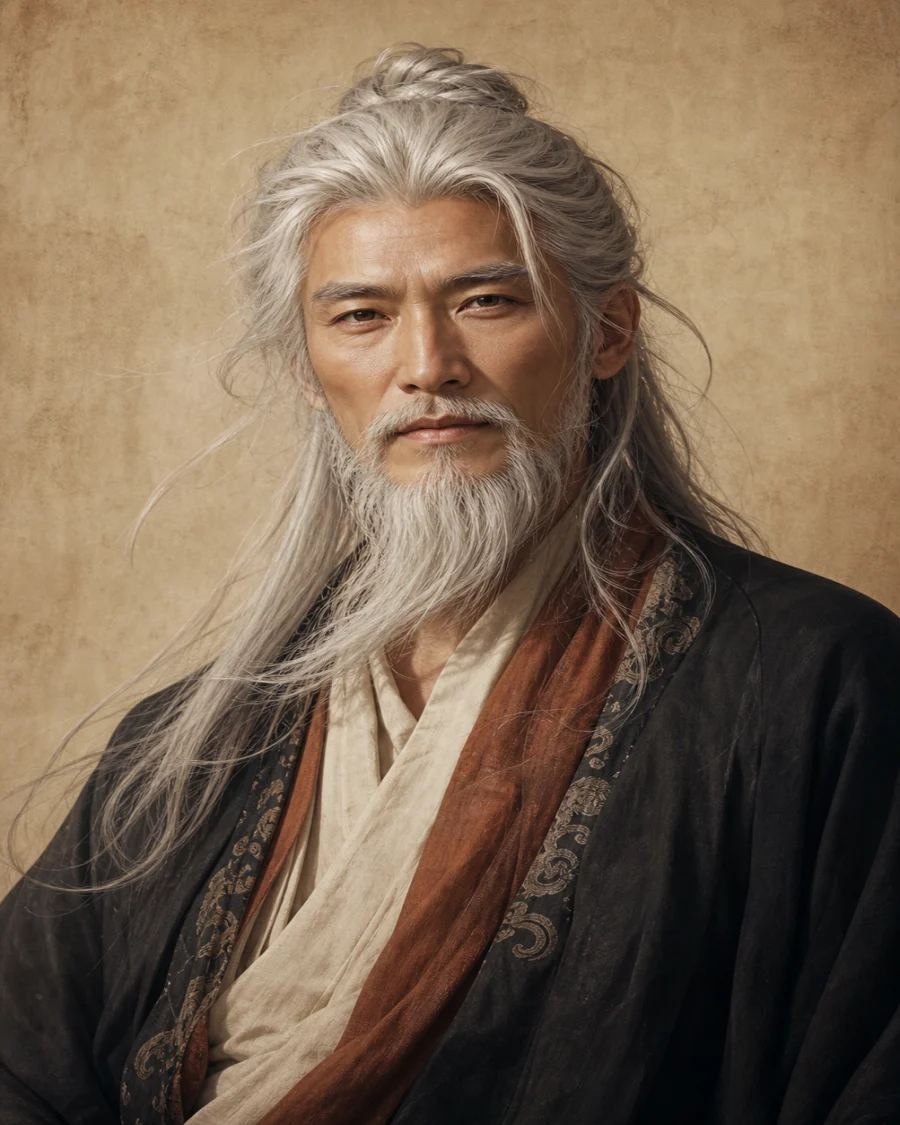
Traditional accounts describe Laozi as an older contemporary of Confucius, an archivist who eventually left the civilized world and composed a short text at a frontier pass. The story is memorable, but historical evidence does not allow it to be treated as straightforward biography. ‘Laozi’ may name a legendary sage, an attributed author, and a textual tradition at once.
The story of leaving a book at the pass
In the tradition reported by Sima Qian, Laozi leaves a declining Zhou world and reaches a pass. The keeper, Yin Xi, asks him to leave teaching before departing. He writes about the Way and virtue and then disappears from the story. This is a famous account of withdrawal and authorship, not a verified travel diary with a securely reconstructed itinerary.
The narrative is interesting because departure does not mean leaving nothing behind. Withdrawal from power is paired with a text for others. That meaning can be examined without claiming the story has been established as an event. It appears here explicitly as a tradition, so that its cultural importance does not become a false claim about an undocumented personal experience.
An uncertain author's life does not prevent investigation of a text's history. Manuscript finds at Guodian and Mawangdui invite comparison of wording and arrangement. Assuming a single finished book written at one moment makes differences look merely accidental. Considering a history of formation allows a reader to investigate varying emphases without deciding in advance that every passage must speak in precisely the same way.
Water, valleys, softness, and emptiness are not only pleasing natural images. The received text also addresses government, warfare, and the multiplication of desires. Reducing nonaction to a private technique for rest removes those questions. It matters who is asked to use less force and what a ruler might need to stop doing. The image becomes more demanding when connected to the exercise of power.
The Daodejing likely took shape across time. Its short chapters use images rather than a continuous argument: water, valleys, uncarved wood, empty vessels, infants, and rulers who do not advertise control. These are not decorative metaphors surrounding a secret doctrine. They are experiments in seeing how usefulness can arise from receptivity, absence, softness, and fit.
An uncertain life and a continuing text
Laozi is both an attributed philosophical author and a revered figure in religious traditions. These histories interact, but sacred narratives and biographical evidence answer different questions. A report of a miraculous birth does not function like a dated record of public service. Keeping the categories distinct allows religious significance to remain visible without treating it as established chronology.
Modern applications to exhaustion or excessive control can be useful interpretations. Their usefulness does not settle authorship or remove the text's political concerns. This introduction therefore ends without supplying a single, complete personality behind every sentence. An uncertain author can still leave a demanding text. Careful reading begins when the attractive image of the sage no longer substitutes for examining what a passage actually asks.
That perspective is often flattened into ‘go with the flow.’ The text is more politically and ethically demanding. It distrusts aggressive rule, competitive display, excessive desire, and action that multiplies the disorder it claims to solve. Non-forcing does not mean doing nothing. It means learning enough about conditions that action can be precise, timely, and free from the extra violence of needing every result to announce our power.