WHY READ ZHUANGZI
A life under pressure, not a mascot.
The Zhuangzi asks how inherited judgments narrow a life. Its complete twelve-lesson Korean course moves from scale, usefulness, skill, and perspective to mind-fasting, power, embodied difference, friendship, death, language, and the book’s layered authorship. The surviving text contains multiple voices; its stories are philosophical scenes rather than a verified diary of the historical Zhuang Zhou.
Zhuangzi is valuable when a useful judgment has quietly become a judgment about everything. His stories make room for another scale, another way of moving, or another standpoint without promising that difficult choices will disappear.
Especially useful forComparisonBurnoutPerspective
The historical person is not the whole book
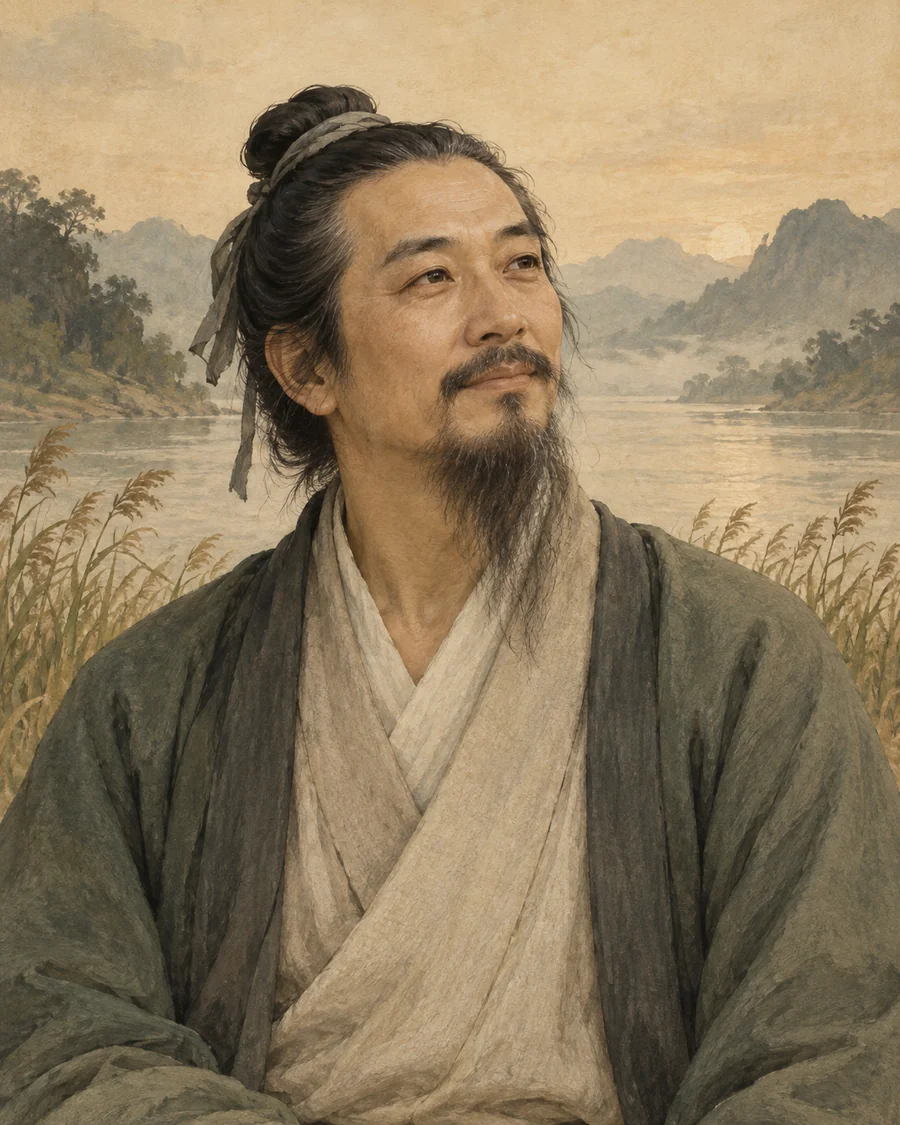
Zhuangzi means Master Zhuang; the personal name associated with him is Zhuang Zhou. Scholarship generally places him in the late fourth century BCE, within the Warring States period. More precise birth and death dates are often circulated, but they should not give an impression of documentary certainty. A responsible introduction can locate his intellectual world while admitting that much of his individual life remains beyond secure reconstruction.
The familiar book is therefore an unusual kind of biographical evidence. Its characters challenge rulers, admire craftspeople, converse with animals, and exchange deliberately difficult questions. Even when a speaker bears the author’s name, the scene has a literary task. Treating every exchange as a recorded event would confuse the history of a person with the argument enacted by a character. The distinction lets the stories retain their force without turning them into invented historical facts.
An assessment can be accurate and still be too narrow to govern a whole life. A tree may fail a carpenter’s requirements while remaining a place where someone can rest. The useful question is not whether every evaluation is false, but which purpose gives it authority. Read this way, the Zhuangzi invites both experimentation with new uses and protection of time that does not have to justify itself through future achievement.
A philosophical world larger than its authorities
In the opening chapter, immense birds and short-lived creatures disturb the reader’s ordinary sense of scale. Hui Shi appears as a disputant whose objections matter: the large gourd and crooked tree are introduced as challenges, not as decorative illustrations of an already settled doctrine. The exchange lets a complaint disclose the assumptions behind it. A reader can examine the relation between purpose and judgment before deciding whether to accept the reply.
The third chapter moves into skilled work, placing a cook before an impressed ruler. The cook describes how his perception changes through practice and how he slows at a difficult joint. Social rank does not settle who has something to teach. These are facts about the surviving narrative rather than proof that its author worked in a kitchen. Learning to distinguish those claims is part of reading a philosopher whose examples often become more famous than the limits of the historical record.
Skill in the Cook Ding story includes a change of pace. Familiar structure allows ease, yet a difficult place calls for concentrated attention and slow movement. This is a demanding picture of competence: practice should improve one’s capacity to notice exceptions, not merely one’s speed. The modern reader must add a separate ethical question, since being adept at an activity does not establish that its purpose is good.
A composite text that keeps asking questions
The received Zhuangzi has thirty-three chapters, conventionally divided into Inner, Outer, and Miscellaneous sections. The Inner Chapters are traditionally associated most closely with Zhuang Zhou, but the exact authorship even within that group remains a subject of scholarship. The book should not be flattened into a single voice speaking with identical commitments at every point.
That textual caution also helps with the butterfly dream at the end of the second chapter. The passage asks about dreaming and waking, then names a distinction between Zhou and the butterfly and speaks of transformation. Reading the entire ending preserves a tension that a short quotation can erase. The three lessons offered here follow similarly complete scenes: they ask what a passage supports, what remains open, and where modern advice requires an additional argument of our own.
The butterfly dream can unsettle the belief that a present identity explains every possible experience. It does not have to become a declaration that facts are imaginary. Between rigid certainty and abandoning judgment lies the work of stating reasons, recognizing the standpoint from which they arise, and naming what could change a decision. That practical reading remains one interpretation of a deliberately challenging text, not a final settlement of its philosophy.