A Copenhagen student of theology
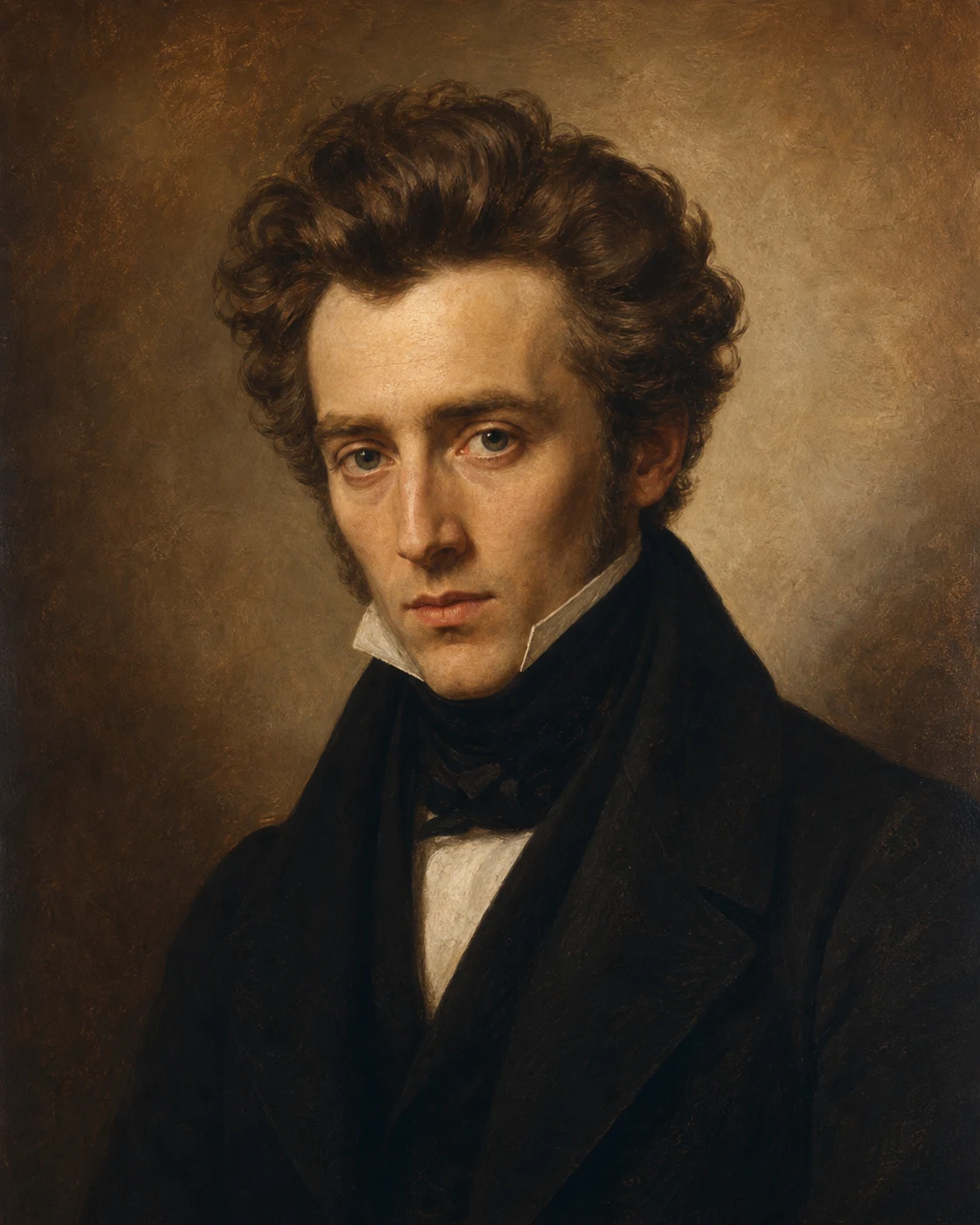
Born in Copenhagen in 1813, Kierkegaard studied theology and wrote on Socratic irony. Philosophical and Christian concerns thus belong together in his intellectual formation. His criticism of the church came from intimate knowledge of its language and education. Reading it simply as rejection of belief misses why the criticism could take the form of a demanding internal challenge.
His father and family religion matter without explaining every book as a single private psychology. Anxiety and despair are also concepts whose arguments require examination. Experiencing a feeling and constructing an account of it are different activities. Biography can show why questions remained urgent without dissolving philosophical work into personal circumstance.
Kierkegaard grew up in Copenhagen in a wealthy household marked by religious seriousness, grief, and his father’s powerful presence. Financial independence later allowed him to write outside a university career, but freedom from employment did not mean freedom from inheritance. Much of his work circles the question of how a person receives a history without letting it decide every possibility in advance.
The broken engagement and public ridicule
Engaged to Regine Olsen in 1840, he broke the engagement the following year. Its place in the writing matters, but a single complete explanation of his motives is not available. Regine should not become a necessary sacrifice for a philosopher's achievement. She had a life of her own. The episode asks how seriously an account of choice considers the person who bears the consequences of someone else's decision.
Conflict with the satirical paper The Corsair later brought public ridicule into his daily life. This supplies a concrete setting for questions about impersonal judgment, though it cannot explain every criticism of the crowd. His own participation in the controversy also matters. Treating the episode only as persecution of an isolated genius removes the choices and escalation through which the conflict developed.
His engagement to Regine Olsen and decision to break it became a central biographical fact, but no single philosophical explanation can settle what happened between two people. Kierkegaard repeatedly transformed the event into literary material about commitment, sacrifice, concealment, and vocation. A careful reader should resist making his pain noble by default. Inward conviction remains ethically accountable to the person who bears its consequences.
The individual through different voices
The pseudonymous books stage differing positions rather than providing one uninterrupted authorial confession. Equating every speaker with Kierkegaard removes part of the reader's task. Understanding a view and existing according to it are different demands. That distinction appears in the form of the writing as well as its explicit claims.
His final attack on the Danish established church, before his death in 1855, challenged the assumption that belonging guaranteed a Christian life. Even readers who do not share his theology can examine the gap between claiming an identity and carrying out its demands. Applying that question today still requires attention to relationships and institutions, rather than making the individual responsible for every condition of existence.
He wrote under pseudonyms whose positions cannot simply be combined into ‘what Kierkegaard believed,’ then published direct religious discourses under his own name. Late in life he attacked the established Danish church and the comfort of collective Christianity. Across these modes, the crowd is dangerous when it lets an individual borrow judgment without responsibility. Yet individuality is not isolation; Works of Love insists that care becomes real through demanding practices toward actual others.