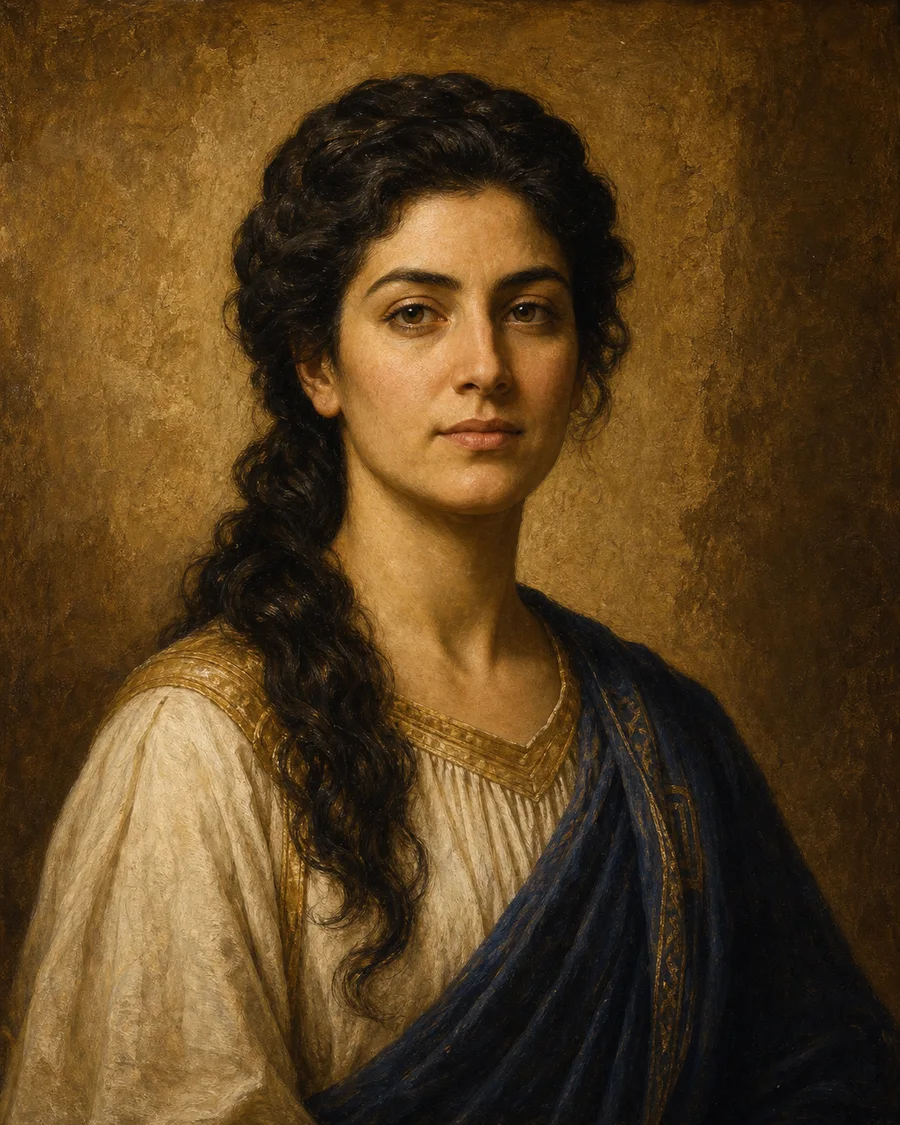
Intellectual independence is a practice of disciplined attention, not a pose.
WHY READ HYPATIA
A life under pressure, not a mascot.
Hypatia taught philosophy, mathematics, and astronomy in late-antique Alexandria. Her own works are almost entirely lost, so a responsible account begins with the limits of the record: letters from her student Synesius and later, sometimes conflicting narratives about her public teaching and violent death.
Hypatia matters because she joined exacting study to public teaching in a city where intellectual authority, civic influence, and religious conflict could not be kept apart. Her story also disciplines our appetite for a perfect heroine: the evidence is real, important, and incomplete.
Especially useful forLearningIndependent judgmentCivic courage
Reading Hypatia through the evidence
Why was Hypatia killed? Separate the record from the interpretation
A Christian mob killed Hypatia in Alexandria in 415. In Church History 7.15, Socrates Scholasticus connects the attack with a slander that she obstructed reconciliation between the prefect Orestes and bishop Cyril. This account does not support the claim that she was executed for a particular scientific discovery.
A one-sentence account can hide who knew what. Here we separate a source's statements, its author's judgments, and our own conclusions. That distinction helps us identify both supported responsibility and unproven claims without diminishing the violence.
Three sources answer different questions
Socrates Scholasticus · Church History 7.13–15
A fifth-century church historian, not the Athenian philosopher Socrates
What this source supports
He connects civic conflict, slander, and the attack led by Peter. He condemns the killing and treats it as a disgrace to the Alexandrian church.
What it cannot establish on its own
Proximity in time does not make this an eyewitness statement. This passage does not supply direct evidence of an order to kill from Cyril.
A student's request addressed to Hypatia during her lifetime
What this source supports
Synesius requests a brass instrument and describes its tube and markings. The letter illuminates a relationship involving technical knowledge as well as philosophical education.
What it cannot establish on its own
It does not establish delivery of the instrument or identify Hypatia as its first inventor. Nor is it an account of her death.
A seventh-century author's later account, transmitted through multiple languages
What this source supports
He portrays Hypatia with hostility, associates her with magic, and praises her attackers. The passage shows a later narrative justifying the violence.
What it cannot establish on its own
A hostile accusation is not evidence that magic occurred. Disagreement with Socrates does not make the midpoint between their judgments a historical fact.
How should we read accounts that condemn or praise the same killing?
The two histories direct readers toward different judgments. Socrates distinguishes slander from the attack; John uses a hostile portrayal to justify it. Their disagreement calls for separating an author's justification from the action described. It does not require suspending every ethical judgment about that action.
Three questions help. Who carried out the attack? Who ordered it? What arrangements of power and hostility made it possible? These concern direct action, a chain of command, and wider responsibility. Answering the first does not settle the other two. Uncertainty about the second does not erase the third. This is our framework for examining responsibility, not a doctrine attributed to Hypatia.
Achievements need equally careful reading. Turning a request for an instrument into proof of invention sacrifices evidence in the attempt to honor a scholar. Explanation, checking, teaching, and transmission are distinct forms of skilled contribution. Asking only who invented something first can obscure the work that made knowledge understandable and usable by others.
LIFE & CONTEXT · ABOUT 3 MIN READ
The life behind the philosophy.
Follow the events and choices behind the work. Later traditions and uncertain evidence are identified as the story unfolds.Hypatia: biography contents
The teacher before the final violence
Hypatia's precise birth date is uncertain, while her mathematical and philosophical teaching in Alexandria is well attested. Her association with Theon places her within a learned environment of commentary and instruction. These activities should not be dismissed as merely passing on other people's ideas. Explaining, checking, and preserving demanding knowledge requires expertise and helps determine what later readers can learn.
Letters from Synesius reveal a teacher's authority across a religious difference: he was a Christian and later a bishop. The relationship complicates any account of Alexandria as containing only sealed hostile camps. Before narrating her death, a biography should show the teaching and connections her life made possible. Otherwise the final violence once again displaces a scholar's working life.
Hypatia was the daughter of Theon, an Alexandrian mathematician associated with important editions and commentaries. Sources indicate that she became a respected teacher of philosophy and mathematical sciences, drawing students from beyond Alexandria. The familiar claim that she directed the ancient Library of Alexandria is not supported by the surviving record. Her achievement needs no invented institution: a woman teaching advanced philosophy in public, and being sought out for counsel, was already exceptional in the late Roman world.
415: a life caught in civic conflict
In 415, a Christian mob killed Hypatia amid conflict involving the prefect Orestes and bishop Cyril. An ancient ecclesiastical account records suspicion that she obstructed reconciliation. Reporting that rumor is not endorsing it, and the background does not establish every claimed chain of command. Political setting and directly supported responsibility need to remain distinguishable.
Turning the killing into punishment for one modern-sounding scientific discovery replaces this history with another story. Claims that she proved heliocentrism or was killed for inventing a particular instrument are not used here as facts. Her attested teaching and public standing already matter. How intellectual authority became a target within civic conflict deserves attention without an embellished narrative of solitary genius.
Letters from Synesius of Cyrene, a former student who later became a Christian bishop, show a teacher whose intellectual community crossed religious identities. Other sources connect her with Orestes, Alexandria’s imperial prefect, during his conflict with Bishop Cyril. In 415, a Christian mob murdered Hypatia. The event belongs to a dense civic struggle over authority and faction; reducing it to a simple contest between ‘science’ and ‘religion’ obscures both her philosophy and the politics that made her vulnerable.
Lost works and later symbols
Her work does not survive in a sufficiently complete independent form to settle every attribution. This neither erases her contribution nor licenses filling the gaps with achievements a modern audience would welcome. An account should distinguish what sources report from what remains probable or disputed. The degree of confidence attached to a claim is especially important when the evidence is sparse.
Later fiction and film make her stand for different values. That history of remembrance is worth studying, but invented scenes cannot be returned to antiquity as evidence. Her life asks for more than a two-word contest between faith and reason. Teaching relationships, institutions, civic authority, and the conditions of violence all belong in the picture. Remembering a symbol need not mean forgetting the actual work of a person.
Very little can be assigned to Hypatia’s own hand with certainty. Ancient reports associate her with work on Diophantus, Apollonius, and astronomical texts, while her student’s letters preserve evidence of teaching, instruments, and a durable philosophical relationship. The honest legacy is therefore not a collection of quotable doctrines. It is a model of intellectual authority built through explanation, correspondence, and disciplined inquiry—and a warning about how quickly a public thinker can be turned into a symbol by later ages.
HOW TO READ CAREFULLY
Context changes the lesson.
Treat claims about Hypatia’s works, the Library of Alexandria, and her murder with source-by-source care. Most popular portraits combine later legend with a small body of contemporary or near-contemporary evidence.
Primary works and historical sources
Synesius of Cyrene, Letters to Hypatia
Socrates Scholasticus, Ecclesiastical History, Book 7
Damascius, Life of Isidore, surviving fragments
Theon’s commentary on Ptolemy’s Almagest, Book III heading