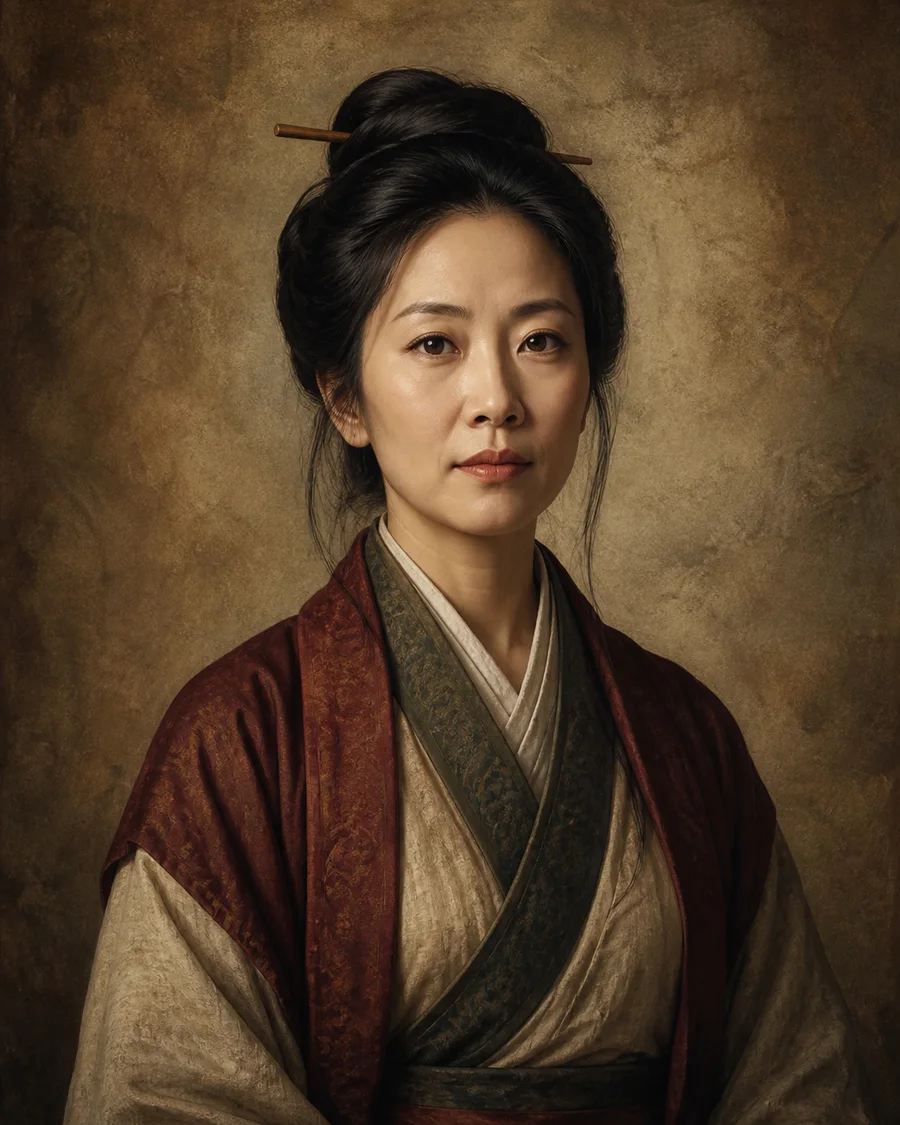
WHY READ BAN ZHAO
A life under pressure, not a mascot.
Ban Zhao was a Han historian, court scholar, teacher, and the earliest known Chinese woman historian. Her life crossed boundaries that her best-known work, Lessons for Women, often appears to reinforce. Reading her well means holding achievement and accommodation together rather than turning her into either a modern heroine or a simple defender of hierarchy.
Ban Zhao matters because her scholarship crossed the very boundaries her society placed around women. Her writings do not offer a simple politics of liberation; they reveal how education, authority, accommodation, and critique can coexist uneasily inside a constrained life.
Especially useful forEducationFamily rolesWorking within constraints
An exceptional route into learning
Ban Zhao grew up in a scholarly family of the Eastern Han. The historical work of her father Ban Biao and brother Ban Gu formed an exceptional route into advanced learning. Describing achievement as talent alone would remove the resources that made it possible. Describing it only as family privilege would, in turn, minimize the expertise required to perform the work.
Dates and some details vary across accounts, so approximate chronology is appropriate. Gaps need not become an uninterrupted success story. Historical compilation, court education, and writing nevertheless meet within a recognizable career. Asking which institutions allowed a learned woman to use her knowledge makes the biography more concrete than attaching one exceptional title to her name.
Ban Zhao was born into a prominent scholarly family during the Eastern Han. Her father Ban Biao and brother Ban Gu worked on the history that became the Book of Han, while another brother, Ban Chao, built a military and diplomatic career. She received an advanced classical education from both sides of her family. That background was privileged, but not trivial: it gave a woman access to historical method, literary craft, astronomy, and court scholarship in a culture that sharply divided inner and outer spheres of activity.
Continuing the history her brother left
When Ban Gu died in 92, work on the Hanshu remained unfinished. Ban Zhao contributed to its completion and transmission. This was more than preserving a relative's papers: it involved responsibility for difficult historical material and its intelligibility to readers. Continuing family work and acquiring public scholarly authority intersected. The surviving evidence does not make her the sole author of every remaining component.
Teaching women at court also differed from private authorship. Education transmits knowledge while helping define approved conduct. Expanding the possibility of female learning and participating in the teaching of hierarchy can belong to the same career. Calling her only a liberator or only an instructor in obedience removes the institutional conditions within which those activities occurred.
After Ban Gu died in 92 CE, Ban Zhao was summoned to the imperial library and contributed to the completion and transmission of the Book of Han. She became a teacher to women at court and was consulted by Empress Deng. Her authority was therefore neither merely private nor symbolic. She worked in the production of official history and helped educate people near power, crossing the inner–outer boundary without pretending that the structure around her had disappeared.
A historian beyond the conduct book
Lessons for Women became influential as instruction in humility and household roles, while also arguing for women's education. That combination is not simply completed modern equality. A reader must ask what ends and roles education is expected to serve. The opportunity to learn and the freedom to choose a life after learning are connected but different questions.
Remembering only the conduct book obscures work in history, literature, and teaching. Biography also examines why one text fits later needs and other activities become less visible. Her career asks whether achievements within constraints can be recognized while the constraints are criticized. A person's failure to stand wholly outside an era need not erase her work, and accomplishment need not justify the inequality of that era.
Lessons for Women is her best-known work and her most contested. It urges women to study, but also teaches deference and conduct adapted to patriarchal family order. Reading only as celebration turns accommodation into emancipation; reading only as condemnation erases the unusual scholar who wrote history, poetry, memorials, and political argument. The better question is how a person enlarges education and agency when direct opposition may be unavailable—and where such strategy still reproduces the injustice it navigates.